Identification
CAS Number
7012-16-0
Name
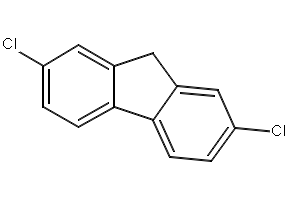
2,7-Dichlorofluorene
Synonyms
2,7-dichlor-9h-fluoren [ACD/IUPAC Name]
2,7-Dichlor-9H-fluoren [German] [ACD/IUPAC Name]
2,7-Dichloro-9H-fluorène [French] [ACD/IUPAC Name]
2,7-Dichlorofluorene
7012-16-0 [RN]
9H-fluorene, 2,7-dichloro- [ACD/Index Name]
Fluorene, 2,7-dichloro-
“2,7-DICHLORO-9H-FLUORENE”
[7012-16-0] [RN]
2,7-dichloro-9-fluorene
2,7-Dichlorofluorene (en)
4,4′-Dichloro-2,2′-methylenebiphenyl
40877-09-6 [RN]
4-Amino-3-benzoylbenzonitrile [ACD/IUPAC Name]
Benzonitrile, 4-amino-3-benzoyl- [ACD/Index Name]
MFCD00032840 [MDL number]
TL8004944
SMILES
c1cc-2c(cc1Cl)Cc3c2ccc(c3)Cl
StdInChI
InChI=1S/C13H8Cl2/c14-10-1-3-12-8(6-10)5-9-7-11(15)2-4-13(9)12/h1-4,6-7H,5H2
StdInChIKey
SDPURBHAHVFTGX-UHFFFAOYSA-N
Molecular Formula
C13H8Cl2
Molecular Weight
235.109
MDL Number
MFCD00032840
Properties
Appearance
White to light yellow powder
Safety Data
Symbol
 GHS07
GHS07Signal Word
Warning
Hazard statements
H315, H319, H335Precautionary Statements
P261, P305, P338, P351RIDADR
NONH for all modes of transport
WGK Germany
3
Specifications and Other Information of Our 2,7-Dichlorofluorene CAS 7012-16-0
Identification Methods
HNMR, HPLC
Purity
98% min
Loss on Drying
≤0.5%
Shelf Life
2 years
Storage
Under room temperature away from light
Productivity
100MT/month
Known Application
- Organic optoelectronic materials : 2,7-dichlorofluorene can be used as a luminescent material in organic optoelectronic devices
- Pharmaceutical intermediates : It is one of the key intermediates in the synthesis of the anti-malarial drug lumefantrine.
- Synthetic bioactive compounds : Derivatives of 2,7-dichlorofluorene have been studied for anticancer and antimicrobial activity.
Specific applications in organic optoelectronic devices
- Luminescent materials : 2,7-dichlorofluorene and its derivatives can be used as luminescent materials in organic light-emitting diodes (OLEDs). They can be processed into thin films and used to create light-emitting layers.
- Polymer : 2,7-dichlorofluorene can be used to synthesize polymers. These polymers have good solubility and processability and are suitable for use in optoelectronic devices.
- Photoelectric behavior control : By chemically modifying 2,7-dichlorofluorene, the photoelectric behavior in the polymer network can be controlled, thereby improving the performance of the device.
- Photochromic materials : 2,7-dichlorofluorene derivatives have also been studied for photochromic applications, and these materials can change color under different lighting conditions.
Features used in luminescent layer materials
- Good electronic properties : 2,7-dichlorofluorene and its derivatives usually have good electronic properties, which facilitates the transmission and recombination of charge carriers (electrons and holes), thereby improving the luminous efficiency of OLEDs .
- Thermal stability : These compounds usually have high thermal stability, which is important for maintaining the performance stability of OLED devices over long periods of operation.
- Adjustable luminescence color : Through chemical modification, the luminescence color of 2,7-dichlorofluorene derivatives can be adjusted to achieve OLEDs of different colors.
- Solubility : 2,7-dichlorofluorene and its derivatives have good solubility in common organic solvents, which allows them to form uniform films through solution processing techniques (such as spin coating or inkjet printing).
- Photoelectric conversion efficiency : When 2,7-dichlorofluorene derivatives are used as the light-emitting layer in OLEDs, they can provide high photoelectric conversion efficiency, that is, they can effectively convert electrical energy into light energy.
- Luminous efficiency : These materials can achieve high luminous efficiency, which means they can produce higher brightness at lower current density.
What organic light-emitting diodes (OLEDs) can be used in ?
- Light-emitting layer material : 2,7-dichlorofluorene and its derivatives can be used as light-emitting layer materials in OLEDs to generate light.
- Electron transport layer : Derivatives of 2,7-dichlorofluorene may be used as electron transport layers to help improve device efficiency and stability.
- Host material : Among the host materials of OLED, derivatives of 2,7-dichlorofluorene can provide good electronic properties and thermal stability.
- Dopants : 2,7-dichlorofluorene and its derivatives can also be used as dopants and mixed with other organic materials to adjust the luminous color and efficiency of OLEDs.
- Intermediate layer material : In multi-layer OLED structures, derivatives of 2,7-dichlorofluorene can be used as interlayer materials to optimize the injection and transmission of charge carriers.
Links
This product is developed by our R&D company Caming Pharmaceutical Ltd (https://www.caming.com/).
Quick Inquiry
Fill out our inquiry form and one of our experts will be in touch with you shortly.