Identification
CAS Number
611-99-4
Name
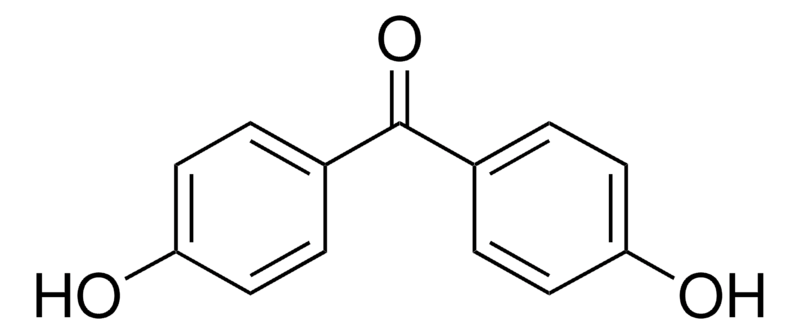
4,4′-Dihydroxybenzophenone
Synonyms
210-288-1
[EINECS]
4,4′-dihydoxy-benzophenone
4,4′-Dihydroxybenzophenone
611-99-4
[RN]
Bis(4-hydroxyphenyl)methanon
[German]
[ACD/IUPAC Name]
Bis(4-hydroxyphenyl)methanone
[ACD/IUPAC Name]
Bis(4-hydroxyphényl)méthanone
[French]
[ACD/IUPAC Name]
Methanone, bis(4-hydroxyphenyl)-
[ACD/Index Name]
MFCD00002358
[MDL number]
SMILES
O=C(c1ccc(O)cc1)c1ccc(O)cc1
StdInChI
InChI=1S/C13H10O3/c14-11-5-1-9(2-6-11)13(16)10-3-7-12(15)8-4-10/h1-8,14-15H
StdInChIKey
RXNYJUSEXLAVNQ-UHFFFAOYSA-N
Molecular Formula
C13H10O3
Molecular Weight
214.220
EINECS
210-288-1
MDL Number
MFCD00002358
Properties
Appearance
White crystalline powder
Melting Point
218.0-220.0℃
Safety Data
Symbol
 GHS07
GHS07Signal Word
Warning
Hazard statements
H315,H317,H319,H335Precautionary Statements
P261 – P264 – P271 – P280 – P302 + P352 – P305 + P351 + P338Personal Protective Equipment
dust mask type N95 (US), Eyeshields, Gloves
RIDADR
NONH for all modes of transport
WGK Germany
3
Specifications and Other Information of Our 4,4′-Dihydroxybenzophenone CAS 611-99-4
Identification Methods
HNMR, HPLC
Purity
99.5% min
Loss on Drying
≤0.5%
Shelf Life
2 years
Storage
Under room temperature away from light
Known Application
- UV absorber
This compound is often used as a UV absorber, especially in sunscreen products and polymer materials to prevent UV-induced degradation. In plastics, rubbers and coatings, 4,4′-dihydroxybenzophenone can be used as an additive to enhance the anti-aging and light stability of the material and extend its service life. - Pharmaceutical intermediates
4,4′-Dihydroxybenzophenone can be used as a pharmaceutical intermediate for the synthesis of antibacterial, anti-inflammatory and antioxidant drugs. The presence of its hydroxyl and carbonyl groups makes it a key starting material for the preparation of biologically active molecules (such as benzimidazole, quinazoline, etc.). - Building blocks in organic synthesis
As an important building block in organic synthesis, this compound can be used to prepare various organic ligands and functional materials. Since the phenolic hydroxyl group in its structure can participate in a variety of chemical reactions, such as acylation, alkylation and condensation reactions, it has important applications in the synthesis of heterocyclic compounds and dyes. - Polymer Stabilizer
In the polymer industry, 4,4′-dihydroxybenzophenone is used as an antioxidant and light stabilizer, especially for improving the light resistance and anti-aging properties of materials such as polyurethane, polyester and polystyrene. This additive can effectively prevent the degradation of materials under ultraviolet radiation and is particularly suitable for plastics and coatings for outdoor applications. - Functional dyes and pigments
The compound can also be used to synthesize dyes and pigments with photoluminescent properties for use in optical materials and electronic displays. The structure of its phenolic hydroxyl group can be further modified to optimize the color properties and stability of the dye. - Analytical reagents
In analytical chemistry, it can be used as a colorimetric reagent or standard to detect the content of certain metal ions or organic matter.
Links
This product is developed by our R&D company Caming Pharmaceutical Ltd (https://www.caming.com/).
Quick Inquiry
Fill out our inquiry form and one of our experts will be in touch with you shortly.

![Structure of Benzo[ghi]perylene CAS 191-24-2](https://www.watson-int.com/wp-content/uploads/2014/12/Structure-of-Benzoghiperylene-CAS-191-24-2.png "Structure of Benzo[ghi]perylene <span class=\"caps\">CAS</span> 191-24-2")