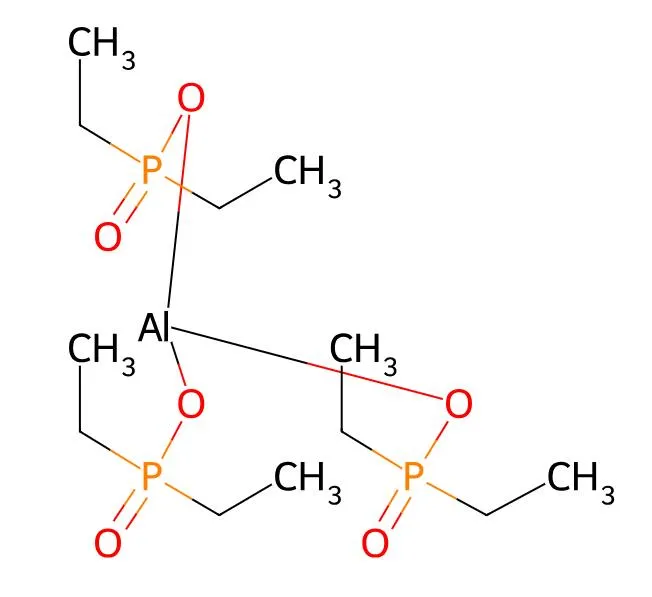
Identification
CAS Number
225789-38-8
Name
Aluminum diethylphosphinate
Synonyms
Aluminium tris(diethylphosphinate)
[IUPAC name – generated by ACD/Name]
Aluminiumtris(diethylphosphinat)
[German]
[IUPAC name – generated by ACD/Name]
Phosphinic acid, P,P-diethyl-, aluminum salt (3:1)
[Index name – generated by ACD/Name]
Tris(diéthylphosphinate) d’aluminium
[French]
[IUPAC name – generated by ACD/Name]
Aluminum diethylphosphinate
Diethylphosphinic acid, aluminum salt
SMILES
InChI=1S/3C4H11O2P.Al/c31-3-7(5,6)4-2;/h33-4H2,1-2H3,(H,5,6);/q;;;+3/p-3
StdInChI
InChI=1S/3C4H11O2P.Al/c31-3-7(5,6)4-2;/h33-4H2,1-2H3,(H,5,6);/q;;;+3/p-3
StdInChIKey
InChI=1S/3C4H11O2P.Al/c31-3-7(5,6)4-2;/h33-4H2,1-2H3,(H,5,6);/q;;;+3/p-3
Molecular Formula
C12H30AlO6P3
Molecular Weight
390.270
EINECS Number
428-310-5
Properties
Appearance
White powder
Safety Data
RIDADR
NONH for all modes of transport
Specifications and Other Information of Our Aluminum diethylphosphinate CAS 225789-38-8
Identification Methods
HNMR, HPLC
Purity
99% min
Whiteness (Wr)
≥96%
Moisture Content
≤0.5%
Bulk Density
0.3~0.6 g/ml
Particle Size
D50 : 20~40um ; D98:<95um
2% Weight Loss Temperature (TGA)
>360°C
Shelf Life
2 years
Storage
Under room temperature away from light
Known Application
Aluminum Diethylphosphinate (ADP) is a highly efficient halogen-free phosphorus-based flame retardant. It is primarily used in engineering plastics such as PA6, PA66, PBT, and PET, and is widely applied in industries including electrical and electronic components, new energy vehicles (NEVs), telecommunications equipment, LED lighting, and household appliances.
ADP is typically used in combination with other flame retardants to achieve enhanced flame-retardant performance and improved processing characteristics. Common synergists include :
Melamine Polyphosphate (MPP): Improves the flame-retardant efficiency of polyamide (PA) materials while reducing the required loading level.
Ammonium Polyphosphate (APP): Used in intumescent flame-retardant systems.
Zinc Phosphinate : Enhances flame-retardant performance and heat resistance.
Glass Fiber (GF): Reinforces the mechanical properties of engineering plastics and works synergistically with flame-retardant systems.
Key Advantages
1.Halogen-free and environmentally friendly
2.High flame-retardant efficiency, requiring relatively low addition levels.
3.Excellent thermal stability, suitable for high-temperature processing.
4.Low smoke generation and reduced emission of corrosive gases during combustion.
5.Minimal impact on the mechanical and electrical properties of the finished materials.
Links
This product is developed by our R&D company Warshel Chemical Ltd (https://www.warshel.com/).
Quick Inquiry
Fill out our inquiry form and one of our experts will be in touch with you shortly.
![Structure of 3-[Tris(trimethylsiloxy)silyl]propyl methacrylateTRIS CAS 17096-07-0](https://www.watson-int.com/wp-content/uploads/2016/01/Structure-of-3-Tristrimethylsiloxysilylpropyl-methacrylateTRIS-CAS-17096-07-0.png "Structure of 3-[Tris(trimethylsiloxy)silyl]propyl methacrylateTRIS <span class=\"caps\">CAS</span> 17096-07-0")
![Structure of Anthra[2,1,9-def6,5,10-d'e'f']diisoquinoline-1,3,8,10(2H,9H)-tetrone CAS 112100-07-9](https://www.watson-int.com/wp-content/uploads/2018/11/Structure-of-Anthra219-def6510-defdiisoquinoline-138102H9H-tetrone-CAS-112100-07-9.gif "Structure of Anthra[2,1,9-def6,5,10-d’e’f’]diisoquinoline-1,3,8,10(<span class=\"caps\">2H</span>,<span class=\"caps\">9H</span>)-tetrone <span class=\"caps\">CAS</span> 112100-07-9")
![Structure of 9-[(4,4,5,5,5-Pentafluoropentyl)thio]nonanol CAS 511545-94-1](https://www.watson-int.com/wp-content/uploads/2014/12/Structure-of-9-44555-Pentafluoropentylthiononanol-CAS-511545-94-1.png "Structure of 9-[(4,4,5,5,5-Pentafluoropentyl)thio]nonanol <span class=\"caps\">CAS</span> 511545-94-1")