
Introduction of Gold Nanoparticles
Gold nanoparticles have been used as effective carriers in lateral flow assays to detect the target analytes in clinical samples. Due to their unique physical and chemical properties, colloidal gold can be easily conjugated with antibodies or antigens without altering their activity or specificity. High-quality gold materials are essential to deliver superior consistency and performance in rapid diagnostic tests.
The interaction of gold nanoparticles with proteins
Adsorption of proteins on the surface of gold nanoparticles is driven by three major forces : electrostatic interaction, hydrophobic binding, and dative bonding. Initially, the negatively charged gold particles will attract positively charged functional groups in proteins. As the proteins approach, hydrophobic patches within them bind to the hydrophobic areas of the gold particles through hydrophobic interactions. Additionally, proteins with sulfur-containing amino acid residues may form Au-S bonds with gold atoms. Therefore, the formation of gold nanoparticle-protein complexes is a complex process that depends on the characteristics of both the proteins and the gold nanoparticles. The shape, size, and surface chemistry of gold play important roles in this process.
Characteristics of gold nanoparticles
The physical properties of gold nanoparticles affect the efficiency and reproducibility of their conjugation with proteins, which, in turn, affect assay sensitivity, specificity and manufacturing consistency. For lateral flow applications, the ideal gold nanoparticles should have the following attributes :
Monodispersity
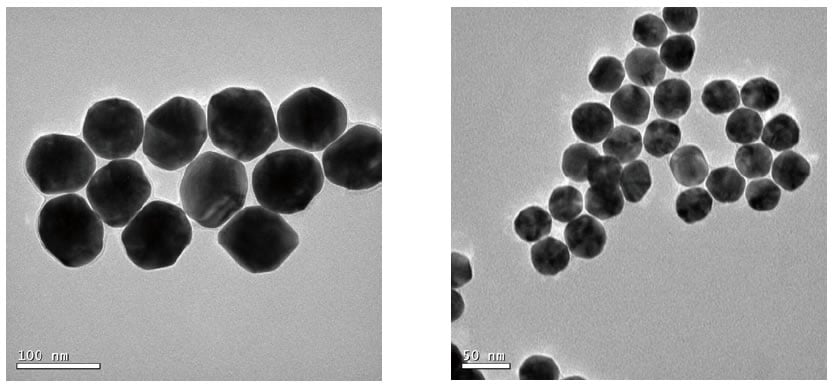
Monodispersity is a key performance parameter for colloidal gold. Monodisperse gold nanoparticles have a uniform size and spherical shape. When a lateral flow test is run, gold conjugates, along with the clinical sample, will flow evenly from the conjugation pad onto the membrane. However, if the gold particles are polydisperse, with different sizes and irregular shapes, the larger gold conjugates will move slower than the smaller ones on the membrane. This difference in flow rate can cause variability in the test results.

Size
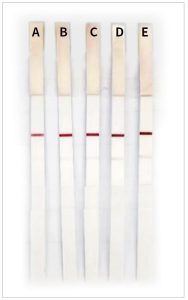
The size of gold nanoparticles directly affects the sensitivity of lateral flow assays. In sandwich immunoassays, larger gold nanoparticles (60nm & 70nm) can achieve higher assay sensitivity than smaller ones (30nm & 40nm).
Left is the sensitivity comparison of five different sizes of gold nanoparticles (WI-30, WI-40, WI-50, WI-60, WI-70) in procalcitonin (PCT) assay by testing human serum samples.
(A)30nm (WI-30); (B)40nm (WI-40); (C)50nm (WI-50); (D)60nm (WI-60); (E)70nm (WI-70)
Colloidal stability
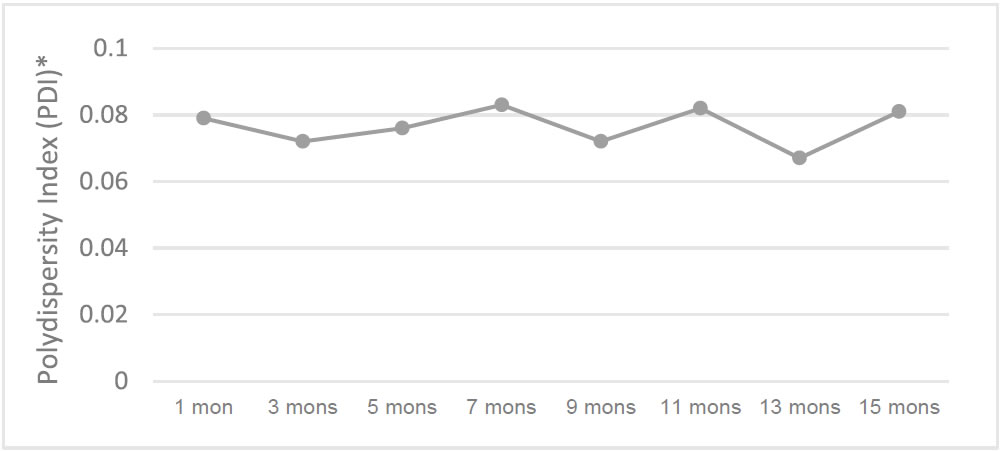
Gold nanoparticles are commonly synthesized by citrate reduction method. Due to the limitations of this method, the dispersion stability decreases when the size of colloidal gold reaches 50nm or larger. Poorly prepared gold nanoparticles tend to be polydisperse and may gradually aggregate over time.
Typically, high-quality gold nanoparticles have a shelf life of at least 12 months under appropriate conditions. It is recommended that manufacturers carry out stability studies to assess the changes in gold materials over extended periods of time before proceeding to the
Real-time stability evaluation of 50nm (WI-50) gold nanoparticles at 2-8°C
test strip production stage.
Comparison of gold conjugation using gold versus conventional gold
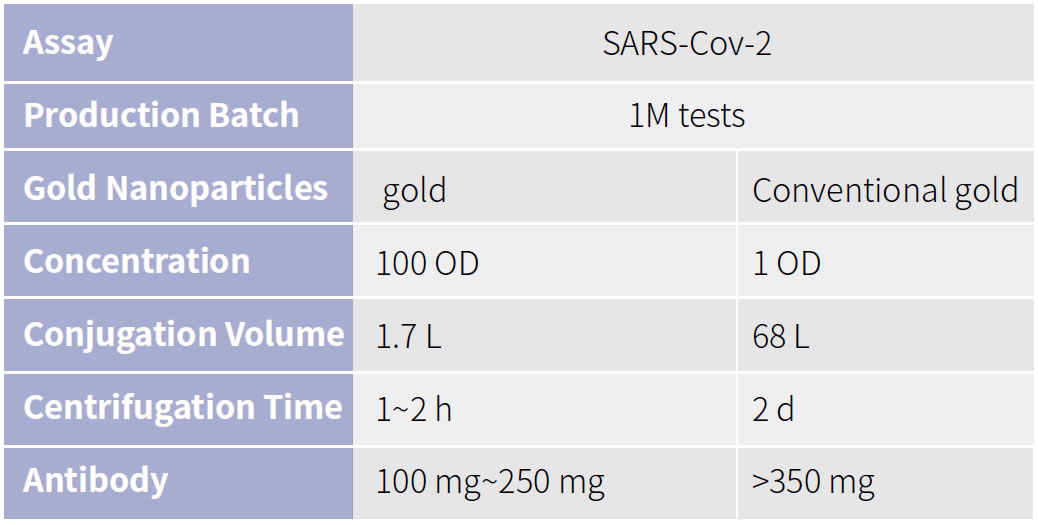
High-concentration gold particles (> 50 OD) offer several advantages over conventional ones (1-5 OD) for lateral flow applications. Conjugating antibodies to gold particles at a
Concentration
high concentration could improve coupling efficiency, as it increases the chances of antibodies attaching to the surface of gold. Additionally, this approach could minimize the reaction volume in the gold conjugation procedure and save time and costs associated with centrifugation steps afterward.
Our gold products are supplied at a concentration of 100 OD, allowing kit manufacturers to perform antibody conjugation at 40 OD. This significantly reduces the cost of reagents (antibody or antigen) by up to two-thirds without sacrificing sensitivity, making it a cost-effective solution for lateral flow applications
Gold Conjugation Protocol
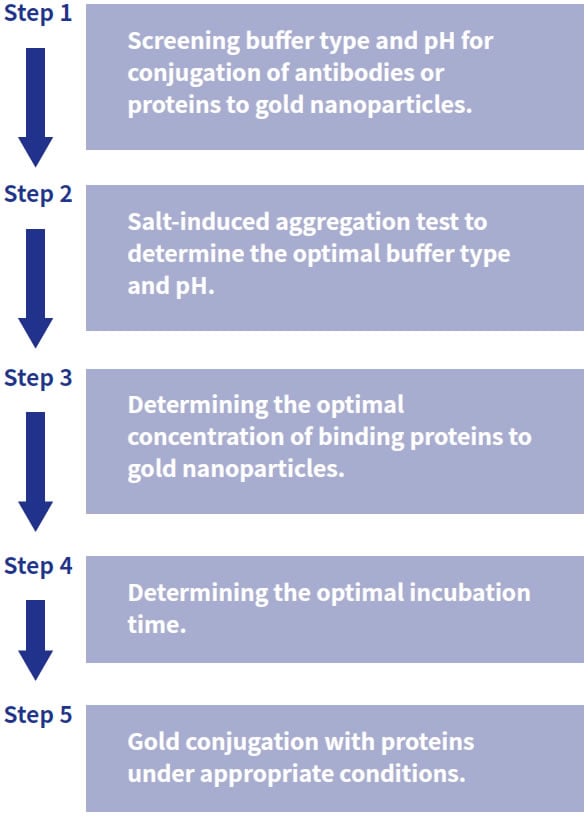
The protocol provides general guidelines for conjugating antibodies or proteins to gold nanoparticles. As proteins vary in their net charge and charge distribution, it is necessary to determine the optimal conjugation conditions, including buffer type, pH, protein concentration and incubation time, through a preliminary experiment before proceeding with the conjugation procedure.
Reagents :
- Old nanoparticles at a concentration of 100 OD
- Antibodies or proteins supplied at a concentration
of >1mg/mL - Gold conjugates storage buffer containing buffer salts,
surfactants, sugars (sucrose or trehalose), and blocking
proteins (BSA or Casein) - 10% (w/v) NaCl solution
- Buffer at the required pH
Protocol
Step 1 : Screening buffer type and pH for conjugation
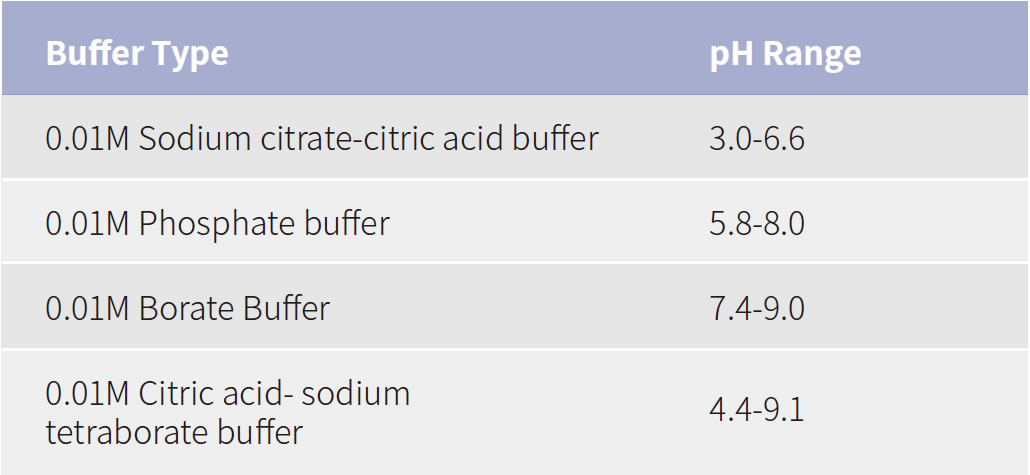
The most commonly used buffers for conjugation are listed below. In our standard procedure, the coupling of proteins to gold nanoparticles is carried out in a set of unique buffers with different pH points. The optimal pH and buffer type are then determined by salt-induced aggregation test in step 2. The following is an example of coupling mouse monoclonal antibodies to gold nanoparticles under various buffer conditions.
Procedure :
1. Add 60 μL of the following four buffers with the required pH to each of the four test tubes.
A. 0.01M Phosphate buffer, pH 6.8
B. 0.01M Phosphate buffer, pH 7.4
C. 0.01M Borate buffer, pH 7.4
D. 0.01M Borate buffer, pH 8.0
Note : As physical and chemical properties can vary significantly between proteins, we suggest experimenting with additional buffer types and pH for your proteins.
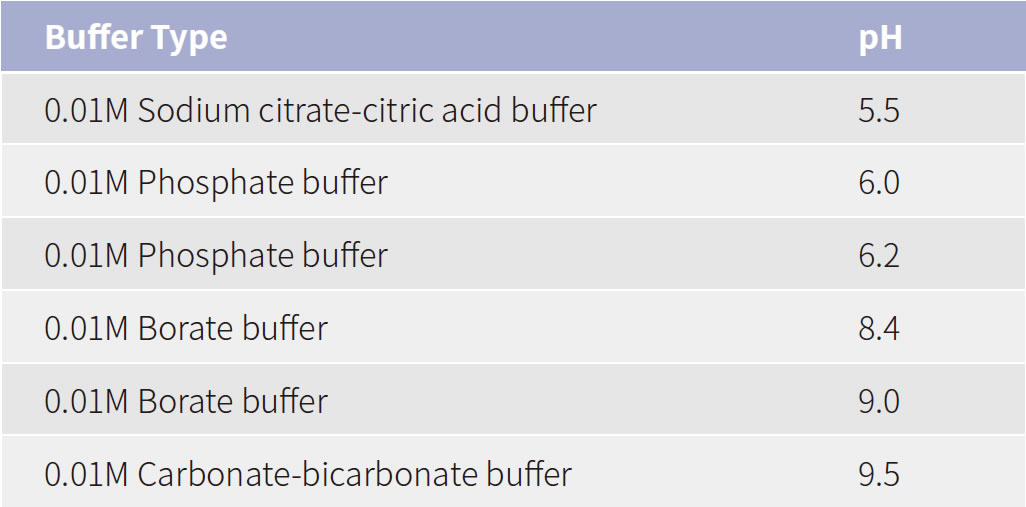
A list of candidate buffer solutions is provided below. Typically, the pH for conjugation should be slightly above the isoelectric point of the binding proteins. This is considered to be a starting point for determining of the appropriate pH. The optimal binding pH may require further fine-tuning using the selected buffer type.
2. Label each tube with all pertinent information.
3. Vortex gold nanoparticles (100 OD) to ensure that the particles are completely suspended.
4. Pipette 40 uL of gold nanoparticles (100 OD) into each tube that contains the four selected buffer solutions with the required pH.
5. Mix and thoroughly vortex the diluted gold nanoparticles (40 OD).
6. Add the appropriate amount of antibody to each labeled test tube. The typical concentration for conjugation in step 1 is 60 ug/mL.
7. React for 2 hours at room temperature with continuous mixing.
8. After conjugation, take a small aliquot (25 uL) of the gold conjugates (40 OD) for further saltinduced aggregation test in step 2.
Step 2 : Salt-induced aggregation test*
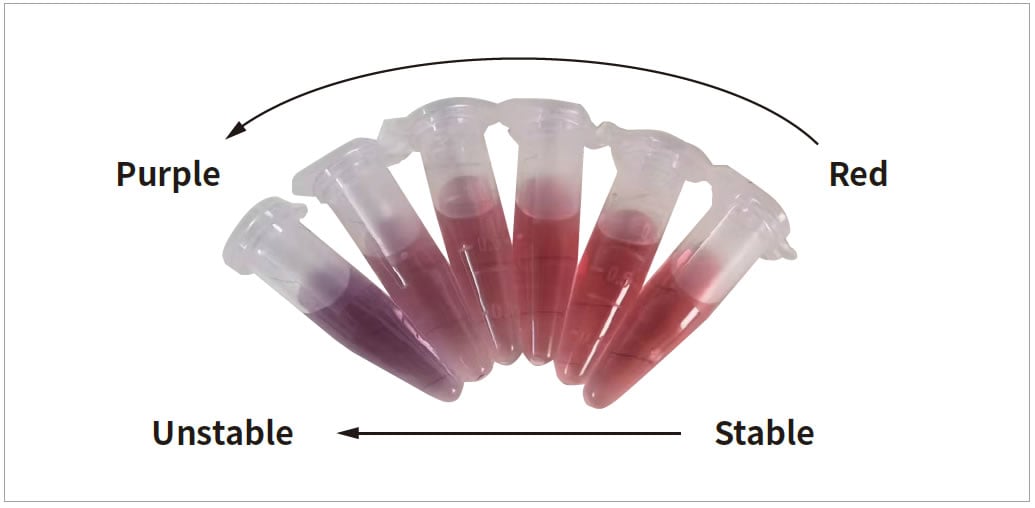
The salt-induced aggregation test is a quick and simple method to monitor the colloidal stability of gold conjugates. Briefly, after conjugation, mix the gold conjugates with a NaCl solution and leave them at room temperature for 5 minutes. A color change from red to purple or blue indicates the aggregation of the gold conjugates below, suggesting that the buffer type and pH may not be suitable for your antibodies or proteins.
Salt-induce aggregation test
Procedure :
1. Add 975 uL of deionized water into each of the four clean test tubes.
2. Pipette 25 uL of gold conjugates (40 OD) into each test tube containing deionized water, to make a final volume of 1 mL (Note : The concentration of gold conjugates is now 1 OD). Label the tubes with all pertinent information.
3. Add 100 uL of 10% (w/v) NaCl solution to each test tube containing the diluted gold conjugates (1 OD).
4. Mix and leave at room temperature for 5 minutes. Observe the color change of the gold conjugates.**
5. Read the results. Select the buffer type and pH that result in the best colloidal stability of gold conjugates.
* To determine the optimal buffer type and pH, the most accurate method is to validate the gold conjugates directly in functional test strips. Select the buffer type and pH that result in optimal sensitivity, specificity, and stability for your assays.
** Use 1 OD of gold nanoparticles as a color control. This can be done by diluting 100 OD of gold nanoparticles with deionized water.
Step 3 : Determining the optimal concentration of binding proteins to gold nanoparticles
1. Add 60 uL of the selected buffer with the required pH to each of the four test tubes.
2. Pipette 40 uL of gold nanoparticles (100 OD) into each tube and mix thoroughly.
3. Add the appropriate amount of antibody to each tube to achieve final concentrations of 40 ug/mL, 50 ug/mL, 60 ug/mL and 80 ug/mL, respectively.*
4. React for 2 hours at room temperature with continuous mixing.
5. Add 5 uL of 10% (w/v) BSA solution to the gold conjugates (40 OD). Mix thoroughly and leave at room temperature for 1h.**
6. After blocking, centrifuge at 2310 g for 10 min. The time and speed of the centrifugation depend on the size of gold nanoparticles and should be adjusted
accordingly for optimal performance.
7. Remove the supernatant and resuspend gold conjugates to a final concentration of 40 OD in gold conjugates storage buffer.
8. Take an aliquot of gold conjugates (40 OD) for further functional testing. Select the antibody concentration that result in optimal sensitivity, specificity, and stability for your assays.
Step 4 : Determining the optimal incubation time
1. Add 60 uL of the selected buffer with the required pH to each of the four test tubes.
2. Pipette 40 uL of gold nanoparticles (100 OD) into each tube and mix thoroughly.
3. Add the appropriate amount of antibody determined in step 3 to each of the four test tubes.
4. React at room temperature for 30min, 60min, 90min and 120min, respectively.
5. After conjugation, take a small aliquot (25 uL) of gold conjugates (40 OD) for further salt-induced aggregation test in step 2.
6. Repeat step 2 to determine the optimal incubation time.*
* To determine the optimal incubation time, the most accurate method is to validate the gold conjugates directly in functional test strips. Select the incubation time that result in optimal sensitivity, specificity, and stability for your assays.
Step 5 : Gold conjugation with proteins under appropriate conditions
1. Add 60 uL of the selected buffer with the required pH to the test tube.
2. Pipette 40 uL of gold nanoparticles (100 OD) into the tube and mix thoroughly.
3. Add the appropriate amount of the antibody and react at room temperature for the optimal time determined in step 4.
4. Add 5 uL of 10% (w/v) BSA solution to the gold conjugates (40 OD). Mix thoroughly and leave at room temperature for 1h.*
5. After blocking, centrifuge at 2310 g for 10 min. The time and speed of the centrifugation depend on the size of gold nanoparticles and should be adjusted accordingly for optimal performance.
6. Remove the supernatant and resuspend gold conjugates to a final concentration of 40 OD in gold conjugates storage buffer.
7. Mix thoroughly and store at 4℃ for further use.
* The optimal blocking agents need to be determined experimentally for each assay. BSA, Casein, or other commercial blockers are commonly used in lateral flow applications
![Structure of Ferrocene, 1-(diphenylphosphino)-2-[(1R)-1-[[2-[[(1R)-1-(hydroxymethyl)-2,2-dimethylpropyl]amino]-2-oxoethyl]amino]ethyl]-, (1R)- CAS 2922459-71-8](https://www.watson-int.com/wp-content/uploads/2025/10/Structure-of-Ferrocene-1-diphenylphosphino-2-1R-1-2-1R-1-hydroxymethyl-22-dimethylpropylamino-2-oxoethylaminoethyl-1R-CAS-2922459-71-8.png "Structure of Ferrocene, 1-(diphenylphosphino)-2-[(<span class=\"caps\">1R</span>)-1-[[2-[[(<span class=\"caps\">1R</span>)-1-(hydroxymethyl)-2,2-dimethylpropyl]amino]-2-oxoethyl]amino]ethyl]-, (<span class=\"caps\">1R</span>)- <span class=\"caps\">CAS</span> 2922459-71-8")