 Identification Properties Safety Data Specifications and Other Information Links
Identification
CAS Number
3211-76-5Name
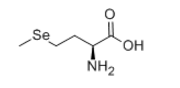
L-(+)-SelenomethionineSynonyms
(2R)-2-amino-4-(methylselanyl)butanoic acid (2R)-2-amino-4-(methylseleno)butanoic acid (2S)-2-Amino-4-(methylseleno)butanoic acid butanoic acid, 2-amino-4-(methylseleno)-, (2R)- L-(+)-Selenomethionine (S)-(+)-2-Amino-4-(methylseleno)butanoic acidMolecular Structure

Structure of L-(+)-Selenomethionine CAS 3211-76-5
SMILES
O=C(O)[C@H](N)CC[Se]CStdInChI
InChI=1S/C5H11NO2Se/c1-9-3-2-4(6)5(7)8/h4H,2-3,6H2,1H3,(H,7,8)/t4-/m1/s1StdInChIKey
RJFAYQIBOAGBLC-SCSAIBSYSA-NMolecular Formula
C5H11NO2SeMolecular Weight
196.11MDL Number
MFCD00037210Properties
Appearance
Off-white to white powderSolubility
50mg in 1ml water clear solubleMelting Point
265 ºCBoiling Point
320.78 °C at 760 mmHgFlash Point
147.803 °CSafety Data
Symbol


 GHS06, GHS08, GHS09
Signal Word
DangerHazard Statements
H301-H331-H373-H410Precautionary Statements
P261-P273-P301 + P310-P311-P501Hazard Codes (Europe)
T,NRisk Statements (Europe)
23/25-33-50/53Safety Statements (Europe)
20/21-28-45-60-61RIDADR
UN 3283 6.1/PG 2WGK Germany
3RTECS
EK7713840Specifications and Other Information of Our L-(+)-Selenomethionine CAS 3211-76-5
Assay
98.0%-102.0%Identification Method
HNMR, MS, HPLCOptical rotation20℃/D(C=1, 1N HCl)
+16.5°~+20°D-Isomer content
0.05% maxArsenic
1 ppm maxCadmium
1 ppm maxMercury
0.1 ppm maxLead
3 ppm maxWater
0.5% maxBiochem/physiol Actions
Selenomethionine displays antioxidant activity and has been shown to increase the activity of glutathione peroxidase in endothelial cells. Glutathione peroxidase protects cells from oxidative damage, such as DNA strand breaks, mutations and interference with protein tyrosine-based signaling and other protein functions due to formation of 3-nitrotyrosine, caused by excessive peroxynitrite. Selenomethionine administration to cancer cell lines (MCF-7/S breast carcinoma, DU-145 prostate cancer cells and UACC-375 melanoma) results in apoptotic cell death and aberrant mitosis. These human tumor cell lines exhibited dose-dependent growth inhibition by selenomethionine in the micromolar range (45 to 130 μM), while growth inhibition of normal fibroblasts required 1 mM selenomethionine.Productivity
1kg/monthStorage Tempeature
Transport at room temperature, long-term preservation at 0 ~ 5°General View of Documents
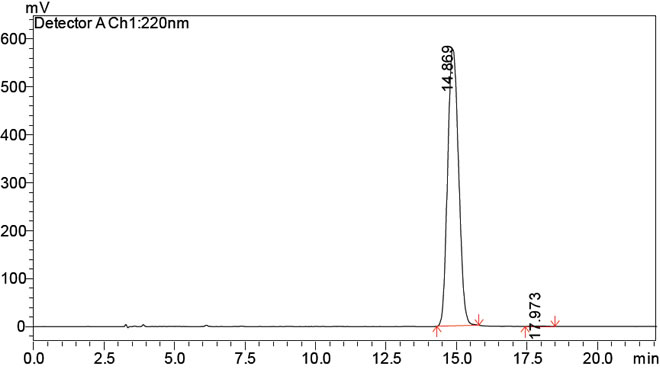
L-(+)-Selenomethionine CAS 3211-76-5 HPLC
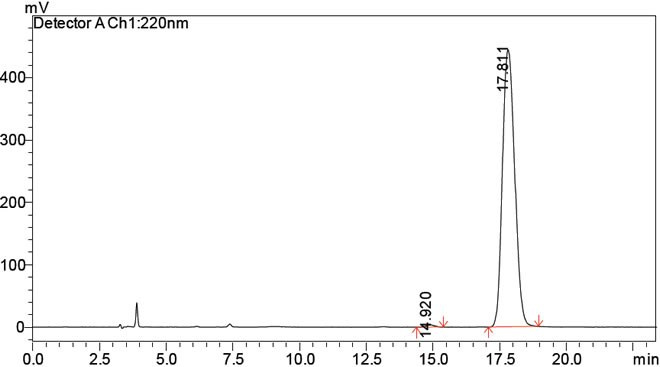
D Type Reference Sample HPLC
![Structure of (R)-RuCl[(p-cymene)(BINAP)]Cl CAS 145926-28-9](data:image/gif;base64,R0lGODlhAQABAIAAAAAAAP///yH5BAEAAAAALAAAAAABAAEAAAIBRAA7 "Structure of (R)-RuCl[(p-cymene)(<span class=\"caps\">BINAP</span>)]Cl <span class=\"caps\">CAS</span> 145926-28-9")
![Structure of (R)-RuCl[(p-cymene)(BINAP)]Cl CAS 145926-28-9](https://www.watson-int.com/wp-content/uploads/2015/05/Structure-of-R-RuClp-cymeneBINAPCl-CAS-145926-28-9.png "Structure of (R)-RuCl[(p-cymene)(<span class=\"caps\">BINAP</span>)]Cl <span class=\"caps\">CAS</span> 145926-28-9")