Freely soluble in methanol and in toluene, soluble in ethylether, sparingly soluble in hexane, practically insoluble in water.
Safety Data
Personal Protective Equipment
Eyeshields, Gloves, type N95 (US), type P1 (EN143) respirator filter
WGK Germany
3
Specifications and Other Information of Our Mirtazapine CAS 61337-67-5 (85650-52-8)
Standard
USP
Identification
IR
Assay
98%-102% (anhydrate substance)
Water
1.0%-3.5%
Residue on Ignition
0.1% max
Heavy Metals
10ppm max
Residual Solvents
Dimethyl sulfoxide : 880ppm max Tetrahydrofuran : 720ppm max Toluene : 890ppm max Chloroform : 60ppm max N-heptane : 500ppm max Ethanol : 5000ppm max
Impurities
Impurity A : 0.10% max Impurity B : 0.10% max Impurity C : 0.10% max Impurity D : 0.10% max Impurity E : 0.10% max Individual unspecified impurity : 0.10% max Total impurities : 0.50% max
Package
25kg/drum
Manufacturing Capacity
1 MT/year
Storage
Under room temperature,away from light
Application
Mirtazapine (brand names : Avanza (AU, NZ), Axit (AU), Mirtaz (IN, IE†), Mirtazon (AU), Remeron (AU, CA, HK, IL, NZ†, RU, SG, ZA, US), Zispin (IE, UK); where † indicates discontinued products) is a noradrenergic and specific serotonergic antidepressant (NaSSA) that was introduced by Organon International in the United States in 1996 and is used primarily in the treatment of depression. It is also commonly used as an anxiolytic, hypnotic, antiemetic and appetite stimulant. In terms of structure, mirtazapine can also be classified as a tetracyclic antidepressant (TeCA).

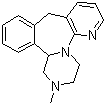
![Structure of 2-chloro-4-methanesulfonyl-3-[(2,2,2-trifluoroethoxy)methyl]benzoic acid CAS 20100-77-8](https://www.watson-int.com/wp-content/uploads/2023/12/Structure-of-2-chloro-4-methanesulfonyl-3-222-trifluoroethoxymethylbenzoic-acid-CAS-20100-77-8.png "Structure of 2-chloro-4-methanesulfonyl-3-[(2,2,2-trifluoroethoxy)methyl]benzoic acid <span class=\"caps\">CAS</span> 20100-77-8")