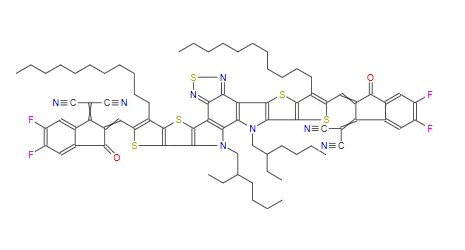
Identification
CAS Number
2304444-49-1
Name
Y6(BTPTT-4F)
Synonyms
PM378 ;
Y6 ;
2,2′-((2Z,2’Z)-((12,13-bis(2-ethylhexyl)-3,9-diundecyl-12,13-dihydro-[1,2,5]thiadiazolo[3,4-e]thieno[2″,3’’:4’,5′]thieno[2′,3′:4,5]pyrrolo[3,2-g]thieno[2′,3′:4,5]thieno[3,2-b]indole-2,10-diyl)bis(methanylylidene))bis(5,6-difluoro-3-oxo-2,3-dihydro-1H-inde ;Y6(BTPTT-4F);
Propanedinitrile,2,2′-[[12,13-bis(2-ethylhexyl)-12,13-dihydro-3,9-diundecylbisthieno[2”,3”:4′,5′]thieno[2′,3′:4,5]pyrrolo[3,2-e:2′,3′-g][2,1,3]benzothiadiazole-2,10-diyl]bis[methylidyne(5,6-difluoro-3-oxo-1H-indene-2,1(3H)-diylidene)]]bis-;
Y6-EH-4F ;
2,2′-[[12,13-Bis(2-ethylhexyl)-12,13-dihydro-3,9-diundecylbisthieno[2”,3”:4′,5′]thieno[2′,3′:4,5]pyrrolo[3,2-e:2′,3′-g][2,1,3]benzothiadiazole-2,10-diyl]bis[methylidyne(5,6-difluoro-3-oxo-1H-indene-2,1(3H)-diylidene)]]bis[propanedinitrile ;
Y6(Y6-EH-4F)
SMILES
CCCCCCCCCCCc3c(C=c2c(=O)c1cc(F)c(F)cc1c2=C(C#N)C#N)sc%11c3sc%12c%10c4nsnc4c9c8sc7c(CCCCCCCCCCC)c(C=c6c(=O)c5cc(F)c(F)cc5c6=C(C#N)C#N)sc7c8n(CC(CC)CCCC)c9c%10n(CC(CC)CCCC)c%11%12
StdInChI
InChI=1S/C82H86F4N8O2S5/c1-7-13-17-19-21-23-25-27-29-33-51-63(39-57-65(49(41-87)42-88)53-35-59(83)61(85)37-55(53)75(57)95)97-81-73-79(99-77(51)81)67-69-70(92-101-91-69)68-72(71(67)93(73)45-47(11-5)31-15-9-3)94(46-48(12-6)32-16-10-4)74-80(68)100-78-52(34-30-28-26-24-22-20-18-14-8-2)64(98-82(74)78)40-58-66(50(43-89)44-90)54-36-60(84)62(86)38-56(54)76(58)96/h35-40,47-48H,7-34,45-46H2,1-6H3
StdInChIKey
XJRVXAOYOOOQLU-UHFFFAOYSA-N
Molecular Formula
C82H86F4N8O2S5
Molecular Weight
1451.94
Properties
Appearance
Powder
Safety Data
RIDADR
NONH for all modes of transport
WGK Germany
3
Specifications and Other Information of Our Y6(BTPTT-4F) CAS 2304444-49-1
Purity
99% min
Mw
Mw>10000
Shelf Life
2 years
Storage
Under room temperature away from light
Known Application
- Non-fullerene Acceptor (NFA)
Y6 is a very important non-fullerene small molecule acceptor material in recent years, with a wide absorption spectrum and low bandgap characteristics. It is often used in combination with donor polymers (such as PM6) to prepare high-efficiency organic solar cells. - Improve the photoelectric conversion efficiency (PCE)
It has achieved an efficiency of over 17% or even over 18%, and is one of the core materials in the research of high-performance OPV devices.
Links
This product is developed by our R&D company Warshel Chemical Ltd (https://www.warshel.com/).
Quick Inquiry
Fill out our inquiry form and one of our experts will be in touch with you shortly.