Identification
CAS Number
2598965-39-8
Name
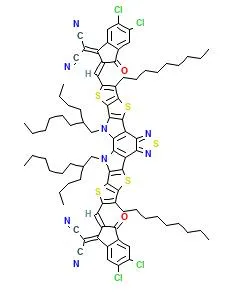
BTP-eC9
Synonyms
2,2′-([12,13-Bis(2-butyloctyl)-3,9-dinonyl-12,13-dihydro[1,2,5]thiadiazolo[3,4-e]thieno[2′,3′:4,5]thieno[3,2-b]thieno[2″,3″:4′,5′]thieno[2′,3′:4,5]pyrrolo[3,2-g]indol-2,10-diyl]bis{(Z)methylyliden[( 2Z)-5,6-dichlor-3-oxo-1H-inden-2,1(3H)-diyliden]})dimalononitril
[German]
[IUPAC name – generated by ACD/Name]
2,2′-([12,13-Bis(2-butyloctyl)-3,9-dinonyl-12,13-dihydro[1,2,5]thiadiazolo[3,4-e]thieno[2′,3′:4,5]thieno[3,2-b]thieno[2″,3″:4′,5′]thieno[2′,3′:4,5]pyrrolo[3,2-g]indole-2,10-diyl]bis{(Z)methylylidene [(2Z)-5,6-dichloro-3-oxo-1H-indene-2,1(3H)-diylidene]})dimalononitrile
[IUPAC name – generated by ACD/Name]
2,2′-([12,13-Bis(2-butyloctyl)-3,9-dinonyl-12,13-dihydro[1,2,5]thiadiazolo[3,4-e]thiéno[2′,3′:4,5]thiéno[3,2-b]thiéno[2″,3″:4′,5′]thiéno[2′,3′:4,5]pyrrolo[3,2-g]indole-2,10-diyl]bis{(Z)méthylylidène [(2Z)-5,6-dichloro-3-oxo-1H-indène-2,1(3H)-diylidène]})dimalononitrile
[French]
[IUPAC name – generated by ACD/Name]
Propanedinitrile, 2,2′-[[12,13-bis(2-butyloctyl)-12,13-dihydro-3,9-dinonyl[1,2,5]thiadiazolo[3,4-e]thieno[2′,3′:4,5]thieno[3,2-b]thieno[2″,3″:4′,5′]thieno[2′,3′:4,5]pyrrolo[3,2-g]indole-2,10-diyl]bi s[(Z)methylidyne[(2Z)-5,6-dichloro-3-oxo-1H-indene-2,1(3H)-diylidene]]]bis-
[Index name – generated by ACD/Name]
2,2′-(((12,13-Bis(2-butyloctyl)-3,9-dinonyl-12,13-dihydro-[1,2,5]thiadiazolo[3,4-e]thieno[2″,3″:4′,5′]thieno[2′,3′:4,5]pyrrolo[3,2-g]thieno[2′,3′:4,5]thieno[3,2-b]indole-2,10-diyl)bis(methanylylidene))bis(5,6-dichloro-3-oxo-2,3-dihydro-1H-indene-2,1-diylidene))dimalononitrile
BTP-eC9
TTBT-eC9
SMILES
CCCCCCCCCc1c(/C=C2\C(=O)c3cc(Cl)c(Cl)cc3C2=C(C#N)C#N)sc2c1sc1c3c4nsnc4c4c5sc6c(CCCCCCCCC)c(/C=C7\C(=O)c8cc(Cl)c(Cl)cc8C7=C(C#N)C#N)sc6c5n(CC(CCCC)CCCCCC)c4c3n(CC(CCCC)CCCCCC)c21
StdInChI
InChI=1S/C86H94Cl4N8O2S5/c1-7-13-19-23-25-27-31-37-55-67(43-61-69(53(45-91)46-92)57-39-63(87)65(89)41-59(57)79(61)99)101-85-77-83(103-81(55)85)71-73-74(96-105-95-73)72-76(75(71)97(77)49-51(33-17-11-5)35-29-21-15-9-3)98(50-52(34-18-12-6)36-30-22-16-10-4)78-84(72)104-82-56(38-32-28-26-24-20-14-8-2)68(102-86(78)82)44-62-70(54(47-93)48-94)58-40-64(88)66(90)42-60(58)80(62)100/h39-44,51-52H,7-38,49-50H2,1-6H3/b61-43-,62-44-
StdInChIKey
PDDSFKXFIQTCTE-ZANQYWCJSA-N
Molecular Formula
C86H94Cl4N8O2S5
Molecular Weight
1573.852
Properties
Appearance
Dark blue powder
Safety Data
RIDADR
NONH for all modes of transport
Specifications and Other Information of Our BTP-eC9 CAS 2598965-39-8
Identification Methods
HNMR, HPLC
Purity
99% min
Shelf Life
2 years
Storage
Under room temperature away from light
Known Application
BTP-eC9 is a high-performance non-fullerene electron acceptor (NFA) widely used in the field of organic photovoltaics (OPVs). Its main applications include :
1.Organic Solar Cells (OSCs): Used as an electron acceptor material to improve charge separation, electron transport, and power conversion efficiency in high-performance organic solar cells.
2.Polymer Solar Cells (PSCs): Commonly paired with polymer donor materials (such as PM6) to fabricate high-efficiency bulk heterojunction (BHJ) solar cells.
3.Organic Semiconductor Research : Utilized in the development of organic semiconductors for studying charge transport, energy level engineering, and molecular packing.
4.Optoelectronic Devices : Suitable for research on photodetectors, flexible electronic devices, and other organic optoelectronic applications.
5.Photovoltaic Materials Development : Used in the design and optimization of next-generation non-fullerene acceptors and high-efficiency photovoltaic materials for academic and industrial R&D.
Key Advantages
- Broad absorption extending into the near-infrared (NIR) region.
- Excellent electron transport properties.
- Favorable energy level alignment with polymer donors.
- High power conversion efficiency and good device stability.
- Good solubility, enabling solution-processing techniques such as spin coating and blade coating.
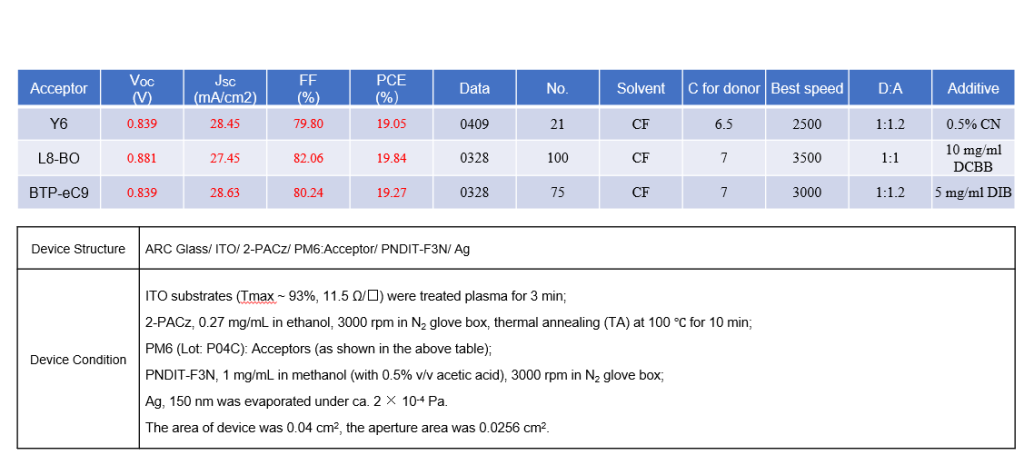
Device Performance And Condition
Links
This product is developed by our R&D company WatsonChem Advanced Chemical Materials (https://www.watsonchem.com/).
Quick Inquiry
Fill out our inquiry form and one of our experts will be in touch with you shortly.