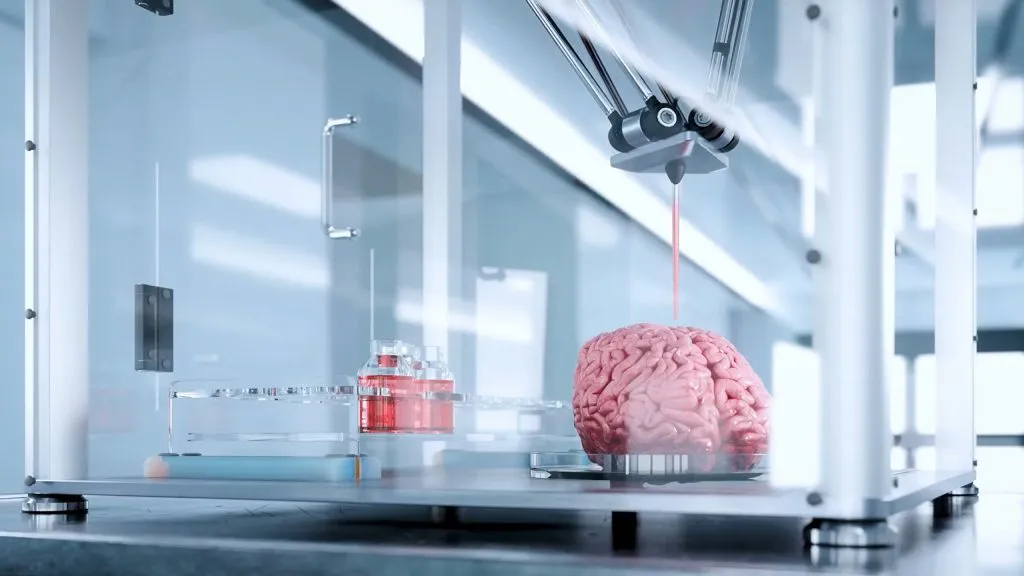
In the rapidly evolving world of photocuring technology, photoinitiators play a pivotal role as core materials, directly influencing curing efficiency, material performance, and application boundaries. As a global leader in photoinitiator solutions, Watson — through its ChemWhat brand — offers a full product lineup in both radical and cationic systems. Backed by deep technical expertise and scenario-based development capabilities, ChemWhat continues to deliver high-value solutions to industries including electronics, printing, automotive, and healthcare, helping customers overcome technical bottlenecks and seize market opportunities.
I. Comprehensive Product Portfolio – Radical and Cationic Systems to Meet Diverse Demands
1. Radical Photoinitiators : Speed and Versatility Combined
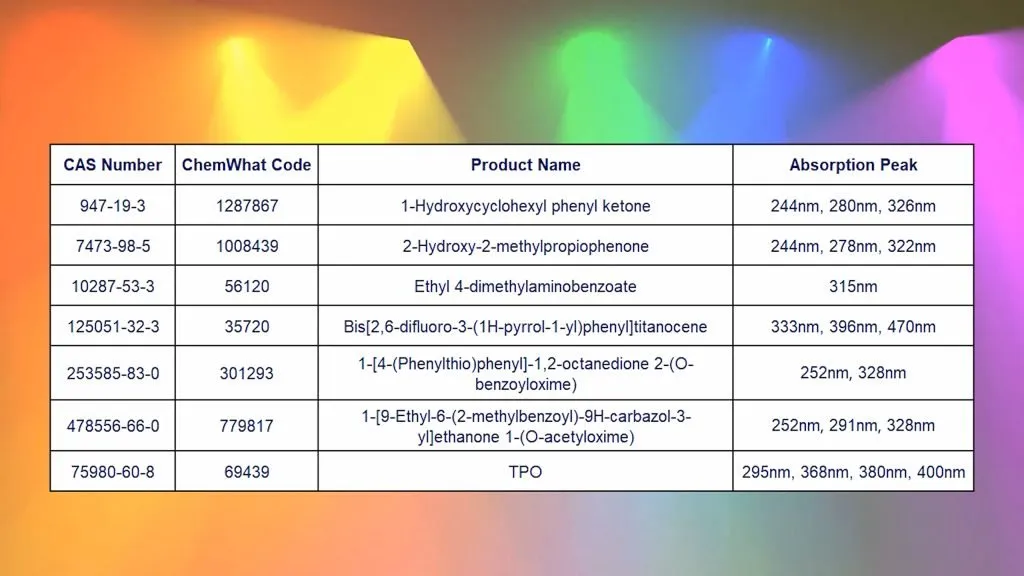
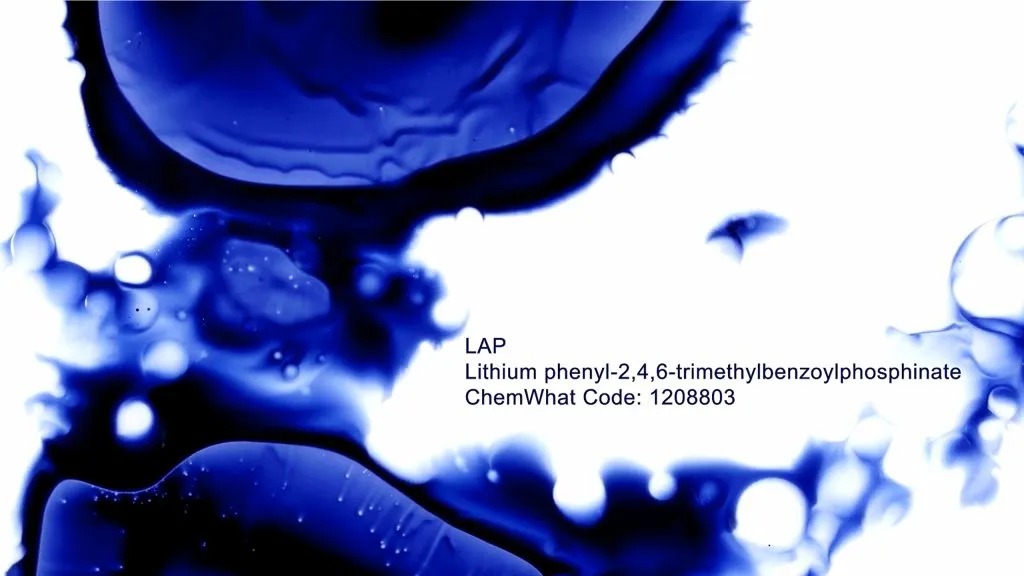
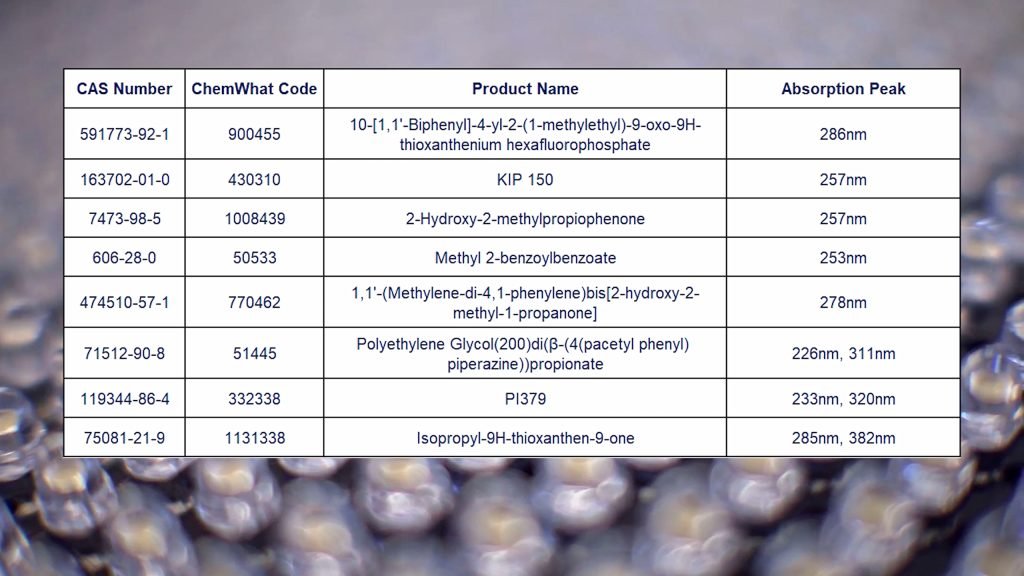
ChemWhat’s radical photoinitiator series is known for its high efficiency, stability, and low yellowing, covering the full spectrum from short wavelengths (250 nm) to long wavelengths (405 nm), and is compatible with LED, mercury, and other light sources :
- Fast-Curing Series :
E.g., ChemWhat benzophenone derivatives, optimized for UV-LED light sources above 395 nm. These offer deep curing capabilities, ideal for 3D printing and thick coating applications. - Anti-Oxygen Inhibition Type :
α-Amino ketones paired with amine co-initiators ensure efficient curing even in open-air environments. Ideal for wood coatings and printing inks. - Low-Migration, Safety-Enhanced Type :
Hydroxy ketones certified for FDA food contact, designed for food packaging inks and medical device coatings, ensuring safety and compliance.
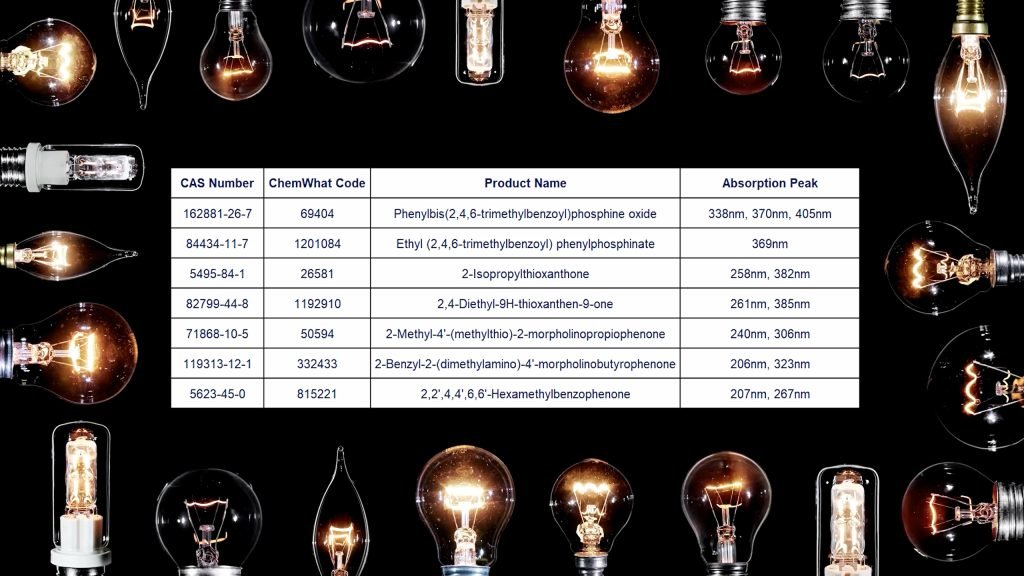
- Innovative Water-Soluble Photoinitiator – LAP (ChemWhat 1208803):
As 3D printing, biomaterials, and light-polymerization technologies evolve, the demand for efficient, low-toxicity photoinitiators is growing. LAP has gained attention for its rapid curing performance under blue light in hydrogel systems, making it ideal for 3D-printed hydrogels, coatings, inks, and bioprinting applications. With its outstanding properties, LAP represents a significant advancement in the field, offering multiple advantages over traditional UV photoinitiators.
2. Cationic Photoinitiators : Benchmarking Depth and Durability
Targeting high-value applications, ChemWhat’s cationic initiators stand out for their high temperature resistance, strong adhesion, and no oxygen inhibition — overcoming conventional curing limitations :
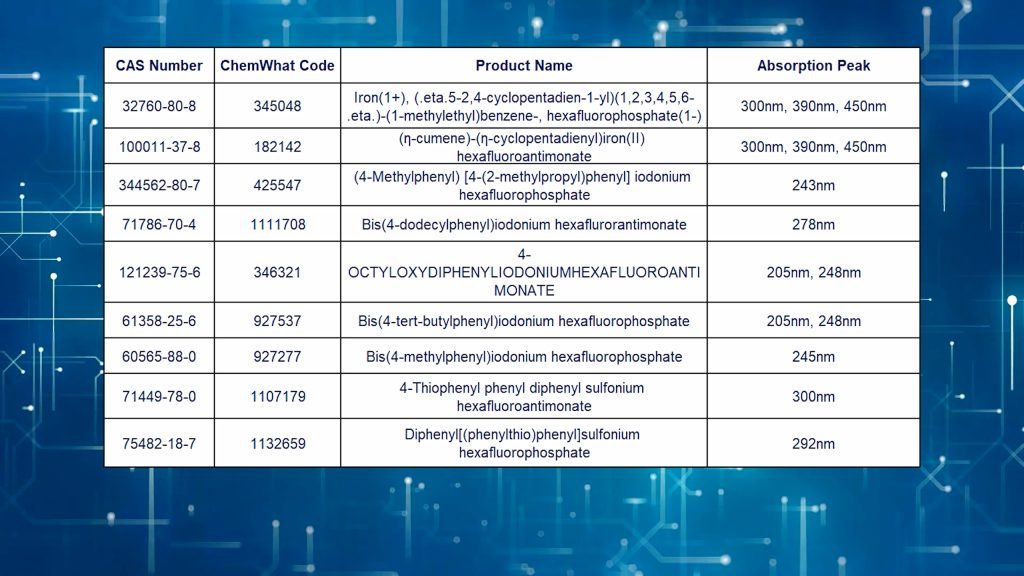
- High-Performance Iodonium Salts :
Trigger rapid ring-opening polymerization of epoxy resins, delivering excellent chemical resistance post-cure. Ideal for electronic encapsulants and optical adhesives. - Moisture-Resistant Sulfonium Salts :
Maintain high reactivity in humid conditions. Suitable for automotive electronics and weather-resistant outdoor coatings. - Dual-Cure Systems :
Combine cationic photoinitiators with thermal curing components to solve shadow area curing challenges in complex assemblies and encapsulation processes.
II. Scenario-Based Solutions – Solving Industry Pain Points with Precision
With a strategy centered on “technology-driven scenario adaptation,” ChemWhat provides customized product combinations tailored to in-depth process knowledge :
1. Electronics Packaging & Semiconductors
- Needs : Low shrinkage, high-temperature resistance (>200°C), high purity
- Solution : Cationic system + epoxy resin + inorganic fillers for low-stress, high-reliability chip packaging
2. 3D Printing & Additive Manufacturing
- Needs : Long-wavelength compatibility, high resolution, low odor
- Solution : Radical system (low-migration type), optimized for 405 nm LED sources, enabling deep cure and smooth surface finish
3. Food & Medical Packaging
- Needs : FDA compliance, non-toxic residue, rapid curing
- Solution : Oligomer blends with optimized initiator concentration and light source parameters for second-level curing and zero-migration risk
4. Automotive & Aerospace
- Needs : Weather resistance, impact resistance, lightweight materials
- Solution : Cationic SI-series + carbon fiber – reinforced epoxy for 30% strength enhancement, ideal for structural adhesives and composites
III. Custom Development Capability – Full-Cycle Support from Molecular Design to Process Implementation
Backed by global R&D centers and joint laboratories, ChemWhat photoinitiators offer end-to-end services from molecular design to production :
1. Custom Molecular Design
Using computational modeling and high-throughput screening, initiators are tuned for specific absorption wavelengths, reactivity, and by-product control. For example, a bisacylphosphine oxide was developed for the emerging 405 nm LED market, increasing photoinitiation efficiency by 20%.
2. Formula Optimization
Compatibility with various substrates (plastic, metal, glass) is ensured by tailoring the blend of initiators, monomers, and additives. For flexible electronics, a low-modulus UV-curable adhesive was developed using elastic monomers with cationic initiators, achieving 100,000 bending cycles without cracking.
3. Process Adaptation & Innovation
Process parameters such as light intensity, exposure time, and temperature are simulated and customized. For example, a gradient light-curing solution was designed for an automotive coating client to address surface shrinkage and internal stress in thick coatings
IV. Technical Support & Service System – Empowering Customer Success Across the Lifecycle
ChemWhat builds a full-service support system with a customer success mindset — spanning pre-sale, in-process, and after-sale stages :
- Pre-Sales Consultation : Technical interviews to quickly identify customer needs and recommend initial options
- Sample Testing : Free product samples and joint performance validation with customers
- After-Sales Support : Troubleshooting and formulation adjustments for mass production
Shaping the Future of Photocuring with Innovation
As photocuring advances toward higher performance, sustainability, and intelligence, Watson remains at the forefront of innovation. Whether through a comprehensive product matrix covering the full light spectrum or scenario-based, personalized development capabilities, ChemWhat is committed to being the most trusted partner for customers. Moving forward, Watson will continue to deepen its R&D, expand application boundaries, and co-create the future of the photocuring industry with global partners.
Choosing ChemWhat means more than choosing a product — it’s choosing a future of continuous innovation.