Identification
CAS Number
28903-71-1
Name
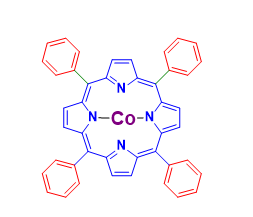
Cobalt(II) meso-Tetra(4-methoxyphenyl)porphine
Synonyms
[5,10,15,20-Tetrakis(4-methoxyphenyl)porphyrinato(2-)-κ2N21,N23]cobalt [ACD/IUPAC Name]
[5,10,15,20-Tetrakis(4-methoxyphenyl)porphyrinato(2-)-κ2N21,N23]cobalt [German] [ACD/IUPAC Name]
[5,10,15,20-Tétrakis(4-méthoxyphényl)porphyrineato(2-)-κ2N21,N23]cobalt [French] [ACD/IUPAC Name]
28903-71-1 [RN]
5,10,15,20-Tetrakis(4-methoxyphenyl)porphyrine cobalt(II) Complex
Arsenite Ionophore I
Cobalt, [5,10,15,20-tetrakis(4-methoxyphenyl)-21H,23H-porphinato(2-)-κN21,κN23]- [ACD/Index Name]
MFCD00010724 [MDL number]
TMOPP-Co
(5,10,15,20-tetrakis(p-methoxyphenyl)-21H,23H-porphyrinate)cobalt(II)
[5,10,15,20-Tetrakis(4-methoxyphenyl)-21H,23H-porphinato]cobalt(II)
[5,10,15,20-Tetrakis(4-methoxyphenyl)porphyrinato]cobalt(II)
5,10,15,20-Tetrakis(4-methoxyphenyl)-21H,23H-porphine cobalt(II)
Co(II) meso-Tetra (4-methoxyphenyl) Porphine (1-3% chlorin)
Cobalt tetramethoxyphenylporphyrin
Cobalttetramethoxyphenylporphyrin
SMILES
COc1ccc(cc1)/c/2c\3/nc(/c(c/4\n5/c(c(\c6n/c(c(\c7n(c2cc7)[Co]5)/c8ccc(cc8)OC)/C=C6)/c9ccc(cc9)OC)/cc4)/c1ccc(cc1)OC)C=C3
StdInChI
InChI=1S/C48H36N4O4.Co/c1-53-33-13-5-29(6-14-33)45-37-21-23-39(49-37)46(30-7-15-34(54-2)16-8-30)41-25-27-43(51-41)48(32-11-19-36(56-4)20-12-32)44-28-26-42(52-44)47(40-24-22-38(45)50-40)31-9-17-35(55-3)18-10-31;/h5-28H,1-4H3;/q-2;+2/b45-37-,45-38-,46-39-,46-41-,47-40-,47-42-,48-43-,48-44-;
StdInChIKey
QBCIMRXPMLWVML-NHZJRHMYSA-N
Molecular Formula
C48H36CoN4O4
Molecular Weight
791.757
MDL Number
MFCD00010724
Properties
Appearance
Dark violet crystalline solid
Safety Data
WGK Germany
3
Specifications and Other Information of Our Cobalt(II) meso-Tetra(4-methoxyphenyl)porphine CAS 28903-71-1
Identification Methods
HNMR, HPLC
Purity
98% min
Shelf Life
2 years
Storage
Under room temperature away from light
Known Application
Co(II)-Tetramesitylporphyrin (CoTMPP) is a cobalt-containing porphyrin derivative, significant in the fields of porphyrin chemistry and coordination chemistry. In these compounds, the cobalt atom is centrally located within the porphyrin ring, surrounded by four mesityl groups. This unique structure endows CoTMPP with distinct chemical properties and broad application potential.
Porphyrins are organic compounds with highly conjugated systems and stable macrocyclic structures. They can form coordination compounds with various metal ions, leading to widespread applications in optics, electronics, catalysis, and other fields. Due to its unique structure, CoTMPP demonstrates significant value in catalysis, medicine, and materials science.
Catalyst : CoTMPP is particularly important in the field of catalysis. It can act as a catalyst for various chemical reactions, including oxidation, reduction, and cyclization reactions. Notably, in organic synthesis, CoTMPP can effectively promote certain reactions, enhancing their selectivity and yield.
Biomimetic Materials : Due to its structural similarity to natural porphyrin compounds such as hemoglobin and chlorophyll, CoTMPP is used in the development of biomimetic materials. These materials show potential applications in mimicking photosynthesis and oxygen transport.
Sensors : Leveraging its ability to specifically interact with various molecules or ions, CoTMPP has been studied as a chemical sensor for detecting specific chemicals or biomarkers in the environment.
Electronic and Optical Materials : Thanks to its excellent electronic and optical properties, CoTMPP is also explored for the preparation of organic semiconductors, organic photovoltaic materials, and organic light-emitting diodes (OLEDs).
As a functional material, CoTMPP exhibits broad application prospects in many scientific and industrial fields due to its unique chemical and physical properties. With ongoing research, more applications are expected to be developed, contributing to scientific research and technological advancement.
Links
This product is developed by our R&D company Warshel Chemical Ltd (https://www.warshel.com/).
Quick Inquiry
Fill out our inquiry form and one of our experts will be in touch with you shortly.