Identification
CAS Number
6645-46-1
Name
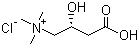
L(-)-Carnitine hydrochloride
Synonyms
(2R)-3-Carboxy-2-hydroxy-N,N,N-trimethyl-1-propanaminium chloride
[ACD/IUPAC Name]
(2R)-3-Carboxy-2-hydroxy-N,N,N-trimethyl-1-propanaminium, inner salt, hydrochloride (1:1)
(2R)-3-Carboxy-2-hydroxy-N,N,N-trimethyl-1-propanaminiumchlorid
[German]
[ACD/IUPAC Name]
(3R)-3-Hydroxy-4-(trimethylammonio)butanoate hydrochloride
(3R)-3-Hydroxy-4-(trimethylammonio)butanoate hydrochloride (1:1)
(3R)-3-Hydroxy-4-(trimethylammonio)butyrate hydrochloride
(R)-3-Carboxy-2-hydroxy-N,N,N-trimethyl-1-propanaminium chloride
(R)-3-Hydroxy-4-(trimethylammonio)butanoate hydrochloride
(R)-3-Hydroxy-4-(trimethylammonio)butyrate hydrochloride
(R)-Carnitine hydrochloride
(−)-β-Hydroxy-γ-(trimethylammonio)butyrate
1-Propanaminium, 3-carboxy-2-hydroxy-N,N,N-trimethyl-, chloride, (2R)- (1:1)[ACD/Index Name]
1-propanaminium, 3-carboxy-2-hydroxy-N,N,N-trimethyl-, inner salt, (2R)-, hydrochloride (1:1)
229-663-6[EINECS]
6645-46-1[RN]
Chlorure de (2R)-3-carboxy-2-hydroxy-N,N,N-triméthyl-1-propanaminium[French][ACD/IUPAC Name]
J3Y5E6IKS3[UNII]
L(−)-Carnitine hydrochloride
L-(−)-Carnitine hydrochloride
L-Carnitine HCl
L-CARNITINE HYDROCHLORIDE
Levocarnitine chloride[JAN]
LEVOCARNITINE HYDROCHLORIDE
MFCD00066100[MDL number]
QV1YQ1K1&1&1 &&Chloride[WLN]
VITAMIN BT
SMILES
C[N+](C)(C)C[C@H](O)CC(=O)O.[Cl-]
StdInChI
InChI=1S/C7H15NO3.ClH/c1-8(2,3)5-6(9)4-7(10)11;/h6,9H,4-5H2,1-3H3 ;1H/t6-;/m1./s1
StdInChIKey
JXXCENBLGFBQJM-FYZOBXCZSA-N
Molecular Formula
C7H16ClNO3
Molecular Weight
197.659
EINECS
229-663-6
MDL Number
MFCD00066100
Properties
Appearance
White crystals or crystalline powder
Safety Data
Symbol
 GHS07
GHS07Signal Word
Warning
Hazard statements
H315,H319,H335Precautionary Statements
P261 – P264 – P271 – P280 – P302 + P352 – P305 + P351 + P338Personal Protective Equipment
dust mask type N95 (US), Eyeshields, Gloves
RIDADR
NONH for all modes of transport
WGK Germany
2
MSDS Download
Specifications and Other Information of Our
Identification Methods
IR, HPLC
Assay
98.0%~102.0%
Specific Rotation
-25.0°~ -22.0°
PH
2.5~2.9
Loss on Drying
≤0.5%
Residue On Ignition
≤0.5%
Chloride
17.0%~18.5%
Heavy Metals
≤10ppm
Arsenic
≤1ppm
Lead
≤3ppm
Mercury
≤0.1ppm
Cadmium
≤1ppm
Shelf Life
2 years
Storage
Store at room temperature, and away from light.
Known Application
- Promote fat metabolism : L-carnitine is mainly responsible for transporting fat to mitochondria in the human body for oxidative decomposition to generate energy. Therefore, it is widely used in fat-reducing products to help improve fat burning efficiency.
- Enhance athletic performance and endurance : As a naturally occurring amino acid derivative, L-carnitine hydrochloride can improve muscle oxidation capacity, helping athletes delay fatigue and improve endurance during training.
- Auxiliary treatment of cardiovascular disease : L-carnitine has a protective effect on the myocardium and is used as an auxiliary treatment for cardiovascular diseases such as cardiomyopathy and heart failure to improve myocardial energy supply.
- Used for kidney disease and dialysis patients : Dialysis patients may lose L-carnitine due to the blood purification process, causing fatigue and muscle weakness. L-carnitine hydrochloride can be used for supplementary treatment to relieve symptoms.
- Auxiliary improvement of sperm quality : L-carnitine helps to improve sperm motility, so it is used to assist in improving male infertility in some cases.
Links
This product is developed by our R&D company Ulcho Biochemical Ltd (http://www.ulcho.com/).
Quick Inquiry
Fill out our inquiry form and one of our experts will be in touch with you shortly.

![Structure of 3-undecylthieno[3,2-b]thiophene CAS 950223-97-9](https://www.watson-int.com/wp-content/uploads/2020/04/Structure-of-3-undecylthieno32-bthiophene-CAS-950223-97-9.png "Structure of 3-undecylthieno[3,2-b]thiophene <span class=\"caps\">CAS</span> 950223-97-9")