Identification
CAS Number
100669-96-3
Name
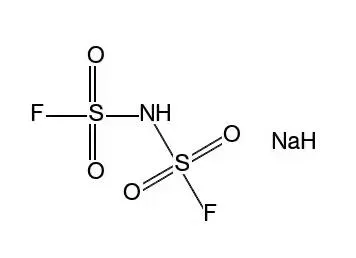
Sodium bis(fluorosulfonyl)imide
Synonyms
NaFSI
Bis(fluorosulfonyl)azanide de sodium
[French]
[IUPAC name – generated by ACD/Name]
Natriumbis(fluorsulfonyl)azanid
[German]
[IUPAC name – generated by ACD/Name]
Sodium bis(fluorosulfonyl)azanide
[IUPAC name – generated by ACD/Name]
SMILES
O=S(=O)(F)[N-]S(=O)(=O)F.[Na+]
StdInChI
InChI=1S/F2NO4S2.Na/c1-8(4,5)3-9(2,6)7;/q-1;+1
StdInChIKey
VCCATSJUUVERFU-UHFFFAOYSA-N
Molecular Formula
F2NNaO4S2
Molecular Weight
203.109
Properties
Appearance
White powder
Safety Data
Signal Word
Danger
Hazard statements
H314Precautionary Statements
P260, P264, P280, P301+P330+P331, P304+P340, P363, P405, P501RIDADR
NONH for all modes of transport
WGK Germany
3
Specifications and Other Information of Our Sodium bis(fluorosulfonyl)imide CAS 100669-96-3
Identification Methods
HNMR, HPLC
Purity
99.9% min
Shelf Life
2 years
Storage
Under room temperature away from light
Advantages
- Excellent Electrochemical Stability
The PF₆⁻ anion possesses a wide electrochemical stability window ; consequently, it is resistant to decomposition even under high-voltage conditions.
This makes it suitable for high-voltage battery systems, where it contributes to improved cycling performance. This is a primary reason why it is widely utilized in lithium-ion batteries, sodium-ion batteries, and supercapacitors. - Superior Ionic Conductivity
In carbonate-based solvents, NaPF₆ exhibits excellent solubility, strong dissociation capabilities, and high conductivity. As a result, it helps to reduce internal battery resistance, enhance rate performance, and improve low-temperature performance. - PF₆⁻ is a Weakly Coordinating Anion
PF₆⁻ demonstrates weak coordination affinity toward metal cations. This offers several advantages : it minimizes interference with reaction active sites, facilitates ion migration, and promotes the formation of stable electrolyte systems. Consequently, it is extensively employed in organic synthesis, catalysis, coordination chemistry, and ionic liquids. - Promotes the Formation of a Stable SEI Film
Within battery systems, the decomposition of PF₆⁻ generates a fluorine-containing interfacial layer, which aids in the formation of a stable SEI (Solid Electrolyte Interphase) film. This, in turn, extends cycle life, improves interfacial stability, and minimizes side reactions. - Achievable High Purity Levels
Battery-grade NaPF₆ can typically be controlled to possess extremely low levels of moisture, metal ions, and HF impurities.
Therefore, it is ideally suited for use in high-end batteries, semiconductor electrochemistry, and precision electronic materials.
Known Application
- Research on Electrolytes for Lithium and Sodium Batteries
NaPF₆ serves as an electrolyte salt for Sodium-ion Batteries (SIBs) and acts as a supporting electrolyte in electrochemical research. For instance, it is soluble in carbonate-based solvent systems such as EC/DEC, PC, and DMC. Due to the superior electrochemical stability and high ionic conductivity of the PF₆⁻ anion, NaPF₆ is frequently utilized in the development of laboratory-scale battery systems. - Anion Exchange Agents in Organic Synthesis
As PF₆⁻ is classified as a weakly coordinating anion, NaPF₆ is commonly employed to : convert halide salts into hexafluorophosphate salts, synthesize quaternary ammonium PF₆ salts, prepare ionic liquids, and facilitate anion exchange in metal complexes. - Supporting Electrolytes in Electrochemistry
It functions as a conductive salt in various electrochemical applications, including cyclic voltammetry (CV), electrodeposition, supercapacitors, and electrocatalysis research. - Functional Materials and Coordination Chemistry
It is utilized in the construction of PF₆⁻ coordination systems within the fields of metal-organic frameworks (MOFs), coordination chemistry, OLED materials, and luminescent materials. - Intermediates for Ionic Liquids
Many PF₆-based ionic liquids are synthesized via anion exchange reactions utilizing NaPF₆.
Links
This product is developed by our R&D company Warshel Chemical Ltd (https://www.warshel.com/).
Quick Inquiry
Fill out our inquiry form and one of our experts will be in touch with you shortly.