 Identification Properties Safety Data Specifications and Other Information Links
Identification
CAS Number
51805-45-9Name
TCEP HCLSynonyms
3,3′,3”-Phosphinetriyltripropanoic acid hydrochloride 3,3′,3”-Phosphinetriyltripropanoic acid hydrochloride (1:1) [ACD/IUPAC Name] 3,3′,3”-Phosphintriyltripropansäurehydrochlorid (1:1) [German] [ACD/IUPAC Name] Acide 3,3′,3”-phosphinetriyltripropanoïque, chlorhydrate (1:1) [French] [ACD/IUPAC Name] Propanoic acid, 3,3′,3”-phosphinidynetris-, hydrochloride (1:1) [ACD/Index Name] Tris(2-carboxyethyl)phosphine Hydrochloride [51805-45-9] 3,3′,3″-phosphinetriyltripropionic acid hydrochloride 3,3′,3”-phosphanetriyltripropanoic acid hydrochloride 3,3′,3”-Phosphinetriyltripropanoicacid hydrochloride 3,3′,3”-Phosphinetriyltripropanoicacidhydrochloride 3,3′,3”-phosphinylidynetris-propanoic acid, monohydrochloride 3-[bis(2-carboxyethyl)phosphanyl]propanoic acid and hydrochloride 3-[Bis(2-carboxyethyl)phosphanyl]propanoic acid hydrochloride 3-[bis(2-carboxyethyl)phosphanyl]propanoic acid;hydrochloride 3-[bis(2-carboxylatoethyl)phosphino]propanoate 51805-45-9 [RN] MFCD00145469 [MDL number] TCEP (hydrochloride) TCEP HCl TCEP, Hydrochloride tri(2-carboxyethyl) phosphine hydrochloride tris(2-carboxyethyl) phosphine hydrochloride tris-(2-carboxyethyl) phosphine hydrochloride tris(2-carboxyethyl)phosphane hydrochloride tris(2-carboxyethyl)phosphine Tris-(2-carboxyethyl)phosphine HCl tris(2-carboxyethyl)-phosphine hydrochloride tris-(2-carboxyethyl)phosphine hydrochloride Tris(2-carboxy-ethyl)phosphine hydrochloride Tris(2-carboxyethyl)phosphine hydrochloride, 0.5M aqueous Tris(2-carboxyethyl)phosphine hydrochloride, 0.5M aqueous solution Tris(2-carboxyethyl)phosphine, HCl TRIS(2-CARBOXYETHYL)PHOSPHINE, HYDROCHLORIDE UNII:H49AAM893K UNII-H49AAM893KMolecular Structure

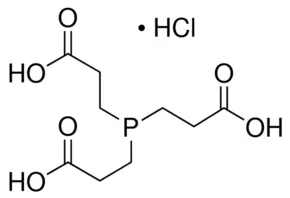
Structure of TCEP HCL CAS 51805-45-9
SMILES
C(CP(CCC(=O)O)CCC(=O)O)C(=O)O.ClStdInChI
InChI=1S/C9H15O6P.ClH/c10-7(11)1-4-16(5-2-8(12)13)6-3-9(14)15;/h1-6H2,(H,10,11)(H,12,13)(H,14,15);1HStdInChIKey
PBVAJRFEEOIAGW-UHFFFAOYSA-NMolecular Formula
C9H15O6P.HClMolecular Weight
286.65Beilstein Registry Number
3724376MDL Number
MFCD00145469Properties
Appearance
Peal yellow powderMelting Point
177±2℃Safety Data
Symbol
Signal Word
DangerHazard Statements
H314Precautionary Statements
P280-P305 + P351 + P338-P310Personal Protective Equipment
Eyeshields, Faceshields, full-face particle respirator type N100 (US), Gloves, respirator cartridge type N100 (US), type P1 (EN143) respirator filter, type P3 (EN 143) respirator cartridgesRIDADR
UN 3261 8 / PGIIWGK Germany
2Specifications and Other Information of Our TCEP HCL CAS 51805-45-9
Standard
Enterprise standardIdentification Methods
HNMR/HPLCPurity
98%minPackage
According to customer requirements to packagingStorage
Under the room temperature and away from lightApplication
Protein disulfide bond reducing agent, also has antioxidant effects. One use is as a thiol TCEP Glycosylation and deprotection reducing agent DNA. TCEP is also often used for the reduction of disulfide bonds in proteins, can be used for intra-protein molecules formed between cysteine blocked protein or intramolecular disulfide bonds. TCEP reducing power stronger than beta- mercaptoethanol and DTT, its effect can be maintained for 2-3 weeks. Whether under acidic or alkaline conditions, TCEP is more stable, better than DTT. TCEP tasteless, non-toxic, water soluble and easier to operate. Unlike DTT also allows Ni reduction, and other biological agents and therefore have better compatibility. Finished facilitate further mass spectrometry.General View of Documents

TCEP HCL CAS 51805-45-9 HNMR

TCEP HCL CAS 51805-45-9 HPLC