I. Power Semiconductor Upgrades Drive Encapsulation Material Innovation
With the rapid adoption of third-generation semiconductors (SiC, GaN), high-power IGBT modules, and automotive-grade power devices, operating current densities and junction temperatures of chips are continuously rising. Traditional tin-based solders (e.g., AuSn, SAC) are increasingly reaching their limits in terms of thermal conductivity, high-temperature reliability, and resistance to thermal fatigue. The industry broadly recognizes that :
- High-Voltage, High-Frequency, and High-Power Density Applications : (e.g., photovoltaic inverters, rail transit, smart grids, and new energy vehicle driving/charging systems) impose more stringent requirements for the thermal conductivity and junction temperature control of encapsulation materials.
- High Aspect Ratio Chips : (e.g., GaN RF devices with aspect ratios up to 5:1 or 6:1) are prone to new issues such as stress concentration and sintering delamination under traditional soldering processes.

- Strategic Autonomy : Crucial fields like national defense, 5G communications, and new energy vehicles urgently require a highly reliable, domestically controllable encapsulation material system to break dependency on imported sintered silver and other advanced Adhesives.
Against this industrial backdrop, ChemWhat has leveraged years of R&D in polymer conductive materials to construct a comprehensive advanced semiconductor encapsulation material system, covering “Conductive Adhesives — Sintered Silver Adhesives — Sintered Copper Adhesives — High-Thermal Conductivity Insulating Adhesives.” ChemWhat’s product development is built on systematic, integrated capabilities spanning “Material R&D — Pilot Verification — Mass Production — Customer Service,” enabling the company to provide solutions for various encapsulation processes, substrate interfaces, and reliability requirements.
II. A Panorama of Advanced Semiconductor Encapsulation Products
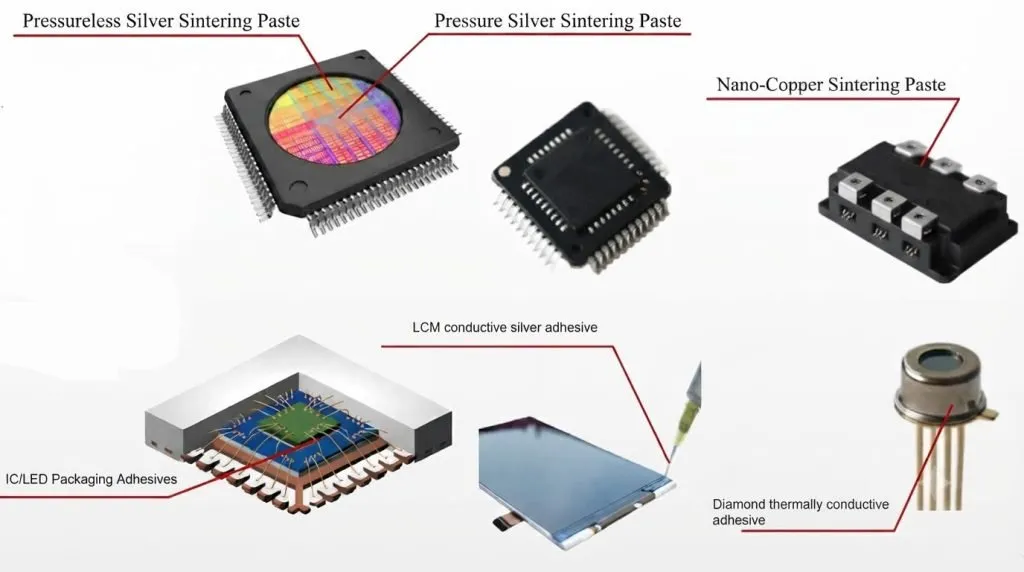
ChemWhat’s advanced semiconductor encapsulation material system is categorized into four major product lines of Adhesives, covering scenarios ranging from low/medium-power IC/LED encapsulation to high-power SiC, GaN, and IGBT modules.
1. Basic Conductive Adhesives : Solutions for Small and Medium-Power Devices
IC Adhesives utilize a single-component epoxy resin silver system. Catering to various curing temperature/time requirements, thermal conductivity grades, and process demands, the product matrix ranges from high-thermal-conductivity hybrid sintered silver Adhesives (92% silver content, 60 W/m·K thermal conductivity, used for ultra-high-power scenarios like TO-247/Power QFN automotive SiC encapsulation) to general-purpose high-silver-content Adhesives (80% silver content, covering SOT, QFP, and aerospace ICs). These products meet reliability standards such as HAST, TCT, MSL, HTOLT, and PCT.
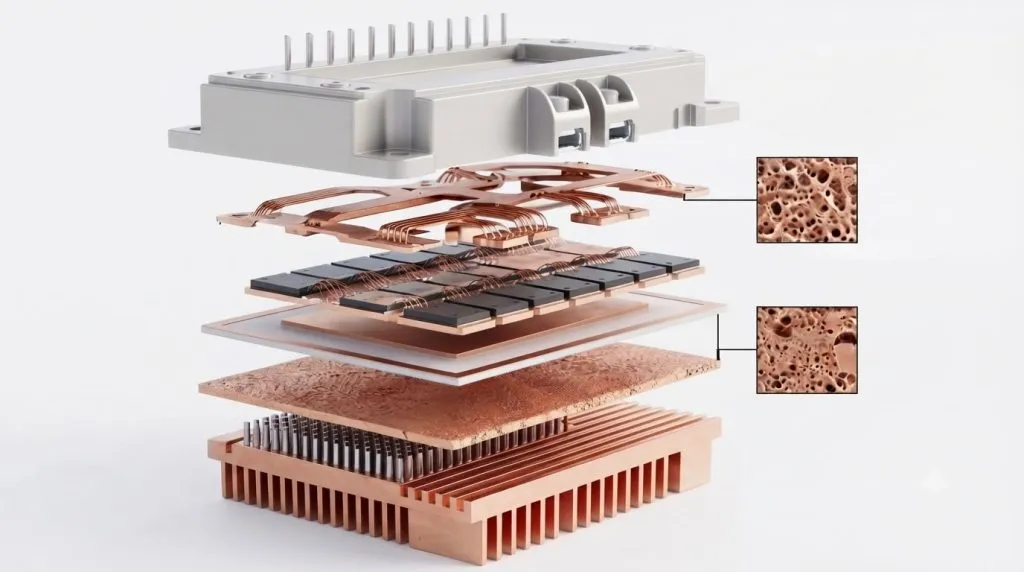
LED die-attach Conductive Adhesives are designed for the die-bonding process between upright LED chips and substrates. In high-power LED fields, these balance conductivity, thermal capability, and aging stability. With silver contents ranging from 87% to 95%, these Conductive Adhesives deliver thermal conductivities up to 60 W/m·K, volume resistivities as low as 9×10⁻⁶ Ω·cm, and shear strengths typically exceeding 7 – 10 MPa. Specialized low-warpage Conductive Adhesives have been developed for large-area chip bonding and various CTE interface matching, supporting chips up to 10×10 cm, with zero failures in reliability testing.
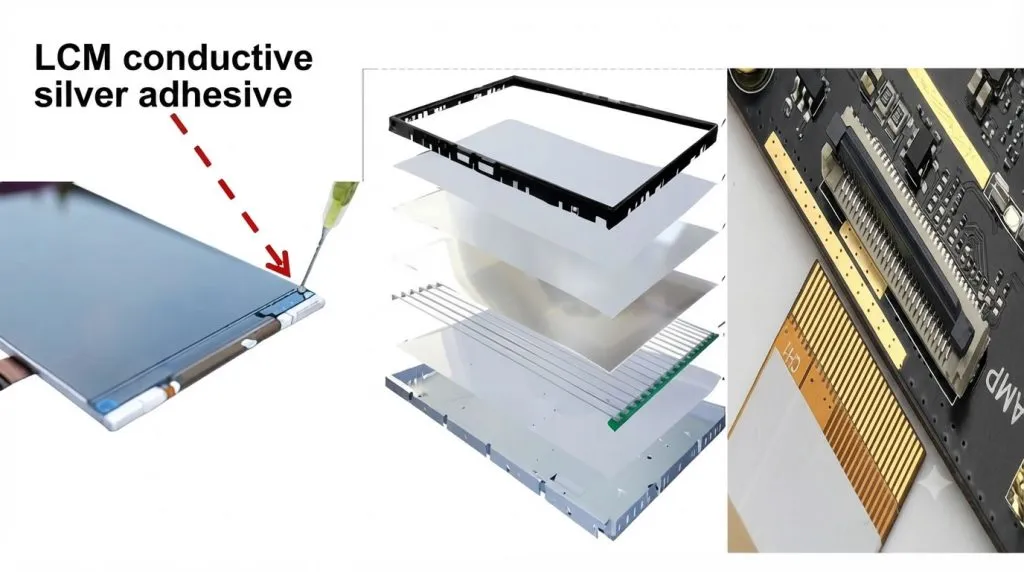
LCM Conductive Adhesives, refined from modified polyurethane, neutral solvents, and silver powder fillers, feature strong compatibility with various substrates and minimal penetration, achieving a volume resistivity of 5×10⁻⁴ Ω·cm and adhesion ≥3B. Designed for EFD syringe packaging and automated dispensing equipment with fast self-curing capabilities, they are widely used in the LCD and LCM module industries.
2. Pressureless Sintered Silver Conductive Adhesives : Core Material for Third-Generation Semiconductor Encapsulation
Pressureless sintered silver Conductive Adhesives are ChemWhat’s flagship product line, primarily targeting third-generation semiconductor scenarios including GaN power devices, high-power RF chips, optoelectronic chips, and automotive-grade power device integration.
Available in semi-sintered and fully sintered types, the fully sintered variant achieves thermal conductivity of up to 260 W/m·K and enables rapid low-temperature sintering at 160 – 180°C. Shear strengths can reach the 80 MPa level, with near-zero porosity for chips smaller than 5×5 mm. ChemWhat’s mastery of these formulas and sintering curves — which critically influence conductivity, thermal properties, and bond strength — represents a core technological barrier for these Conductive Adhesives.
3. Pressure-Sintered Silver and Sintered Copper Conductive Adhesives : For High-Power SiC and IGBT Modules
Pressure-sintered silver Conductive Adhesives, with a 90% silver content, achieve thermal conductivity exceeding 260 W/m·K and shear strengths over 70 MPa (Ag die/Cu interface @ 230°C, 10 MPa, 5 min), making them ideal for high-power SiC device encapsulation.
Sintered copper Conductive Adhesives represent the cutting-edge “all-copper interconnect” route. In power module packaging, achieving all-copper interfaces between the chip, the Conductive Adhesives, and the substrate eliminates risks of electromigration in heterogeneous metal interfaces and resolves CTE mismatch issues. With thermal conductivity exceeding 220 – 250+ W/m·K and shear strengths of 47 – 64 MPa on AMB/DBC copper plates, these Conductive Adhesives are particularly suitable for automotive-grade high-power IGBT modules.
4. High-Thermal Conductivity Insulating Conductive Adhesives : Balancing Thermal Management and Electrical Isolation
For applications requiring both thermal conductivity and electrical insulation, such as sensors, IC packaging, and MEMS, ChemWhat offers high-thermal-conductivity insulating Conductive Adhesives. Utilizing a single-component system with 70% diamond filler content, they achieve thermal conductivity >36 W/m·K, breakdown strength of 10 kV/mm, and volume resistivity of 2.7×10¹² Ω·cm. They function within a temperature range of -40 to 200°C and are widely used for heat-sensitive components like thermopile sensors.
III. From Laboratory to Mass Production : Reliability Verification System
All ChemWhat Conductive Adhesives undergo a systematic testing process, including preconditioning (baking, MSL) followed by rigorous reliability verification : PCT (121°C/100%RH, 168 hours), TCT (-65°C to 150°C, 500/1000 cycles), THT (85°C/85%RH, 500/1000 hours), and HTST (175°C, 500/1000 hours), ensuring consistency and stability from laboratory data to mass production.
IV. Supporting Industrial Autonomy through Material Innovation
From basic Conductive Adhesives for small/medium-power IC/LEDs to sintered silver/copper Conductive Adhesives for GaN/SiC and automotive-grade IGBT modules, ChemWhat has built a comprehensive product matrix covering the full spectrum of advanced semiconductor encapsulation. By prioritizing high-performance and high-quality customer value, ChemWhat provides competitive Conductive Adhesives solutions for critical fields including intelligent manufacturing, new energy vehicles, and 5G communications.