Identification
CAS Number
33454-82-9
Name
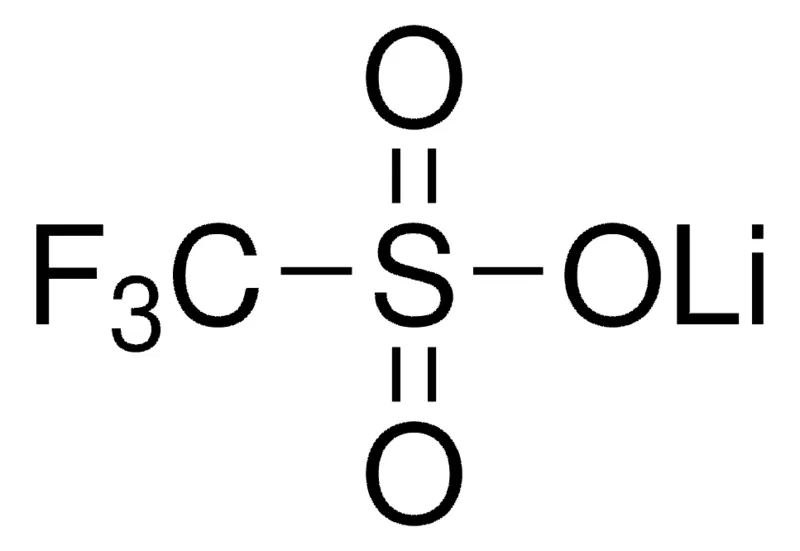
Lithium trifluoromethanesulfonate
Synonyms
lithium triflate
Lithium trifluoromethanesulfonate
[IUPAC name – generated by ACD/Name]
lithium trifluoromethanesulphonate
Lithiumtrifluormethansulfonat
[German]
[IUPAC name – generated by ACD/Name]
Methanesulfonic acid, 1,1,1-trifluoro-, lithium salt (1:1)
[Index name – generated by ACD/Name]
Trifluorométhanesulfonate de lithium
[French]
[IUPAC name – generated by ACD/Name]
Trifluoromethanesulfonic acid lithium salt
Trifluoromethanesulfonic acid, lithium salt
Disconnected organometallic ; Unsuitable organometallic
Li triflate
lithium and trifluoromethanesulfonate
lithium trifluoromethane sulfonate
lithium trifluoromethanesulfonate,
Lithium Trifluoromethylsulfonate
lithium(1+) ion trifluoromethanesulfonate
LITHIUM(1+) TRIFLATE
LITHIUM(1+) TRIFLUOROMETHANESULFONATE
lithium ; trifluoromethanesulfonic acid
lithium ; tris(fluoranyl)methanesulfonic acid
lithium;trifluoromethanesulfonate
lithium;trifluoromethanesulfonic acid
methanesulfonic acid, trifluoro-, lithium salt
Trifluoromethanesulfonate lithium
trifluoromethanesulfonic acid lithium
SMILES
O=S(=O)([O-])C(F)(F)F.[Li+]
StdInChI
InChI=1S/CHF3O3S.Li/c2-1(3,4)8(5,6)7;/h(H,5,6,7);/q;+1/p-1
StdInChIKey
MCVFFRWZNYZUIJ-UHFFFAOYSA-M
Molecular Formula
CF3SO3Li
Molecular Weight
156.01
EINECS
251-528-5
Beilstein Registry Number
4301818
MDL Number
MFCD00013227
Properties
Appearance
White powder
Safety Data
Symbol
 GHS07
Signal Word
Warning
Hazard statements
H315,H319,H335Precautionary Statements
P261 – P264 – P271 – P280 – P302 + P352 – P305 + P351 + P338Supplemental Hazard Statements
Risk of explosion if heated under confinement.
WGK Germany
3
Specifications and Other Information of Our Lithium trifluoromethanesulfonate CAS 33454-82-9
Identification Methods
HNMR, HPLC
Purity
99.9% min
Water
≤200ppm
Color (10% w/w aqueous solution)
≤30APHA
K
≤5ppm
Na
≤10ppm
Fe
≤2ppm
Ca
≤5ppm
Ni
≤1ppm
Cr
≤1ppm
Cl
≤10ppm
F
≤10ppm
SO4
≤40ppm
Shelf Life
1 year
Package
280kg/drum
Storage
Under room temperature away from light
Known Application
- New Energy and Energy Storage (Core Applications)
- Lithium-Ion Batteries and Power Batteries : Used as a primary electrolyte salt, auxiliary lithium salt, or functional additive in battery electrolytes. It can provide high ionic conductivity (≥ 10⁻³ S/cm), helping to reduce internal battery resistance.
- High-Voltage Systems and Fast Charging : Features a wide electrochemical stability window (> 4.5 V), making it potentially compatible with high-voltage cathode materials such as NCM811 and lithium cobalt oxide (LCO). It may be suitable for high-voltage power battery systems, including 800V platforms used in new energy vehicles.
- Solid-State Batteries and Lithium-Air Batteries : Can be used as an electrolyte material in solid-state lithium battery systems.
- Supercapacitors : Used as an electrolyte component to improve the charge-discharge performance and stability of supercapacitors.
- Improved Environmental Adaptability : With excellent thermal stability (decomposition temperature > 200°C) and hydrolysis resistance, it may help improve battery performance under high- and low-temperature conditions, suppress capacity degradation, and extend cycle life.
- Fine Organic Synthesis
- Lewis Acid Catalyst : Owing to its weakly coordinating and non-nucleophilic anion characteristics, it can serve as an efficient and mild Lewis acid catalyst in organic synthesis. It offers high catalytic activity with fewer side reactions and can be used in the synthesis of specialty chemicals and polymeric materials.
Links
This product is developed by our R&D company Warshel Chemical Ltd (https://www.warshel.com/).
Quick Inquiry
Fill out our inquiry form and one of our experts will be in touch with you shortly.