Identification
CAS Number
104332-28-7
Name
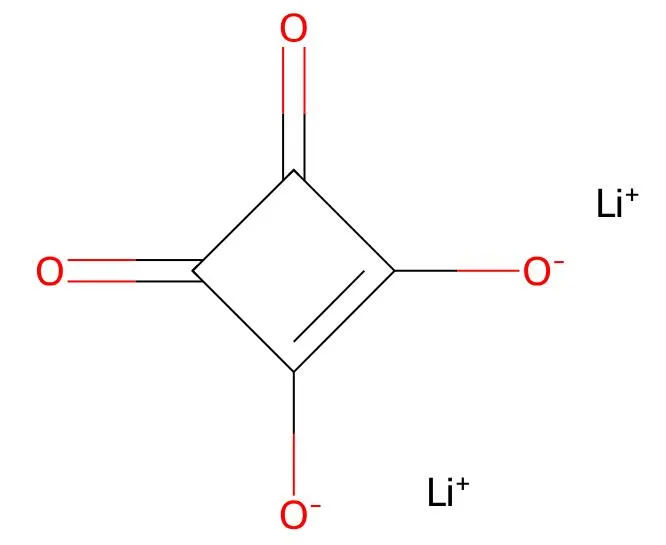
Lithium Squarate
Synonyms
3,4-Dihydroxy-3-cyclobutene-1,2-dione dilithium salt
3,4-Dioxo-1-cyclobutène-1,2-diolate de dilithium
[French]
[IUPAC name – generated by ACD/Name]
3-Cyclobutene-1,2-dione, 3,4-dihydroxy-, lithium salt (1:2)
[Index name – generated by ACD/Name]
Dilithium 3,4-dioxo-1-cyclobutene-1,2-diolate
[IUPAC name – generated by ACD/Name]
Dilithium 3,4-dioxocyclobut-1-ene-1,2-diolate
Dilithium quadratate
Dilithium squarate
Dilithium-3,4-dioxo-1-cyclobuten-1,2-diolat
[German]
[IUPAC name – generated by ACD/Name]
lithium squarate
3,4-DIHYDROXY-3-CYCLOBUTENE-1,2-DIONE, DILITHIUM SALT, 98
3,4-Dihydroxy-3-cyclobutene-1,2-dione,dilithium salt,98
SMILES
O=c1c([O-])c([O-])c1=O.[Li+].[Li+]
StdInChI
InChI=1S/C4H2O4.2Li/c5-1-2(6)4(8)3(1)7;;/h5-6H;;/q;2*+1/p-2
StdInChIKey
SOCJEFTZDJUXNO-UHFFFAOYSA-L
Molecular Formula
C4Li2O4
Molecular Weight
125.922
Properties
Appearance
White powder
PH
7.5±0.5
Safety Data
RIDADR
NONH for all modes of transport
Specifications and Other Information of Our Lithium Squarate CAS 104332-28-7
Identification Methods
Permanganometric Titration
Purity
98% min
Specific Optical Rotation
+31.0-+35.0
Shelf Life
1 year
Storage
Under room temperature away from light
Known Application
- Lithium-Ion Battery Cathode Prelithiation Additive
Used to compensate for active lithium loss during the initial charge-discharge cycles and subsequent cycling of lithium-ion batteries, thereby helping improve capacity retention. - Lithium Iron Phosphate (LFP) Batteries
For LFP power batteries and energy storage batteries, replenishing active lithium may help increase initial usable capacity and improve capacity retention during cycling. - Power Batteries and Energy Storage Batteries
Can be used in the development of prelithiation technologies for electric vehicle power batteries and energy storage batteries. It may help battery manufacturers improve initial lithium utilization, capacity performance, and service-life-related metrics. It is not intended to serve as a direct replacement for conventional lithium salts used in electrolytes. - Battery Materials Research and Formulation Development
Used to evaluate the electrochemical reactions and prelithiation mechanisms of lithium-containing compounds, their compatibility with cathode materials, and the effects of different additive loadings on battery performance.
Advantages
- Compensation for Active Lithium Loss
The primary function of prelithiation materials is to compensate for lithium lost during battery manufacturing and initial cycling. This may help improve initial Coulombic efficiency and usable battery capacity. The actual benefits should be verified through comparative cell testing. - Potential to Improve Capacity Retention and Cycling Performance
By compensating for irreversible lithium loss, prelithiation materials may help slow the depletion of the cyclable lithium inventory, thereby improving long-term capacity retention. However, battery life is also affected by electrode structure, electrolyte composition, temperature, and charging/discharging protocols. - Potential for Further Development and Optimization
The material may be used in the development of novel prelithiation formulations and optimized in combination with cathode materials, electrolytes, and electrode manufacturing processes. It is suitable for formulation screening and performance validation by battery materials companies. - Potentially Improved Stability of Composite Materials
Some suppliers have developed graphene-based lithium squarate composite prelithiation materials and claim that these products offer good environmental stability and leave no solid residues after reaction. However, these claims apply to specific composite products and should not be assumed to represent the properties of all lithium squarate products, particularly pure lithium squarate.
Links
This product is developed by our R&D company Warshel Chemical Ltd (https://www.warshel.com/).
Quick Inquiry
Fill out our inquiry form and one of our experts will be in touch with you shortly.