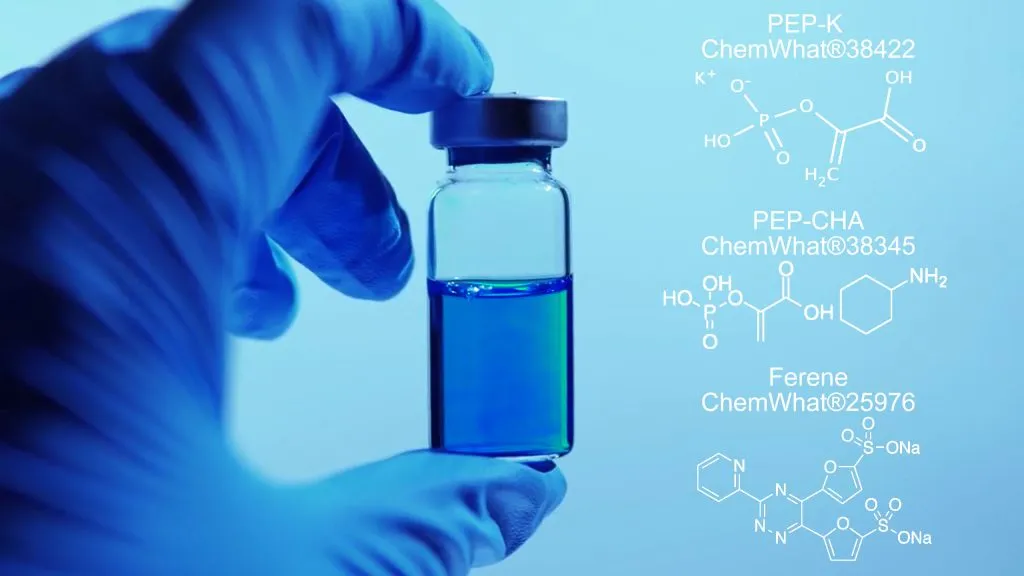
In the precise fields of biochemistry and analytical chemistry, researchers often encounter a confounding issue : when using the same compound — such as Phosphoenolpyruvate Monopotassium Salt (PEP-K, ChemWhat®38422) for metabolic research, Phosphoenolpyruvate Monocyclohexylammonium Salt (PEP-CHA, ChemWhat®38345) for studies, or Ferene Disodium Salt (Ferene, ChemWhat®25976) for precision metal ion detection — they find that despite the market being flooded with suppliers and labels displaying similar chemical purity, the performance of products from different manufacturers varies drastically.
I. Purity is Not Omnipotent : The Neglected “Invisible Quality Boundary”
Most suppliers define chemicals solely through the single dimension of “chemical purity.” However, for biochemical experiments, it is often the “non-standard metrics” beyond the label that determine success or failure.
- Differences in Impurity Profiles : During the synthesis of biochemical molecules, structurally similar by-products are easily generated. While these by-products may possess similar chemical structures, they can act as competitive inhibitors in enzymatic reactions, thereby altering reaction kinetic parameters.
- Metal Ion Interference : In metal ion detection or enzyme activity assays, trace residues of metals — such as Cu²⁺, Fe³⁺, or Zn²⁺ — can cause significant background interference, leading to “false positives” or “enzyme inactivation”.

II. Industrial Production vs. Scientific Application : The Core Threshold for Professional Brands
People often conflate biochemical products with pharmaceutical intermediates ; however, these are essentially two different categories of products. The internal control focus for pharmaceutical intermediates lies in chemical purity, individual impurity content, and total impurity levels, aimed at ensuring the stability of drug synthesis. In contrast, biochemical products are “tool-based products” whose ultimate mission is to participate in complex biochemical reactions.
Therefore, such products must not only be evaluated by their “ingredients” but must also undergo rigorous “usage testing”:
- Validation in Simulated Usage Scenarios : Before leaving the factory, professional brands must pass activity tests corresponding to their intended application. For example, verifying whether the catalytic conversion rate of a substrate is consistent with the standard baseline in automated enzyme kinetic detection systems.
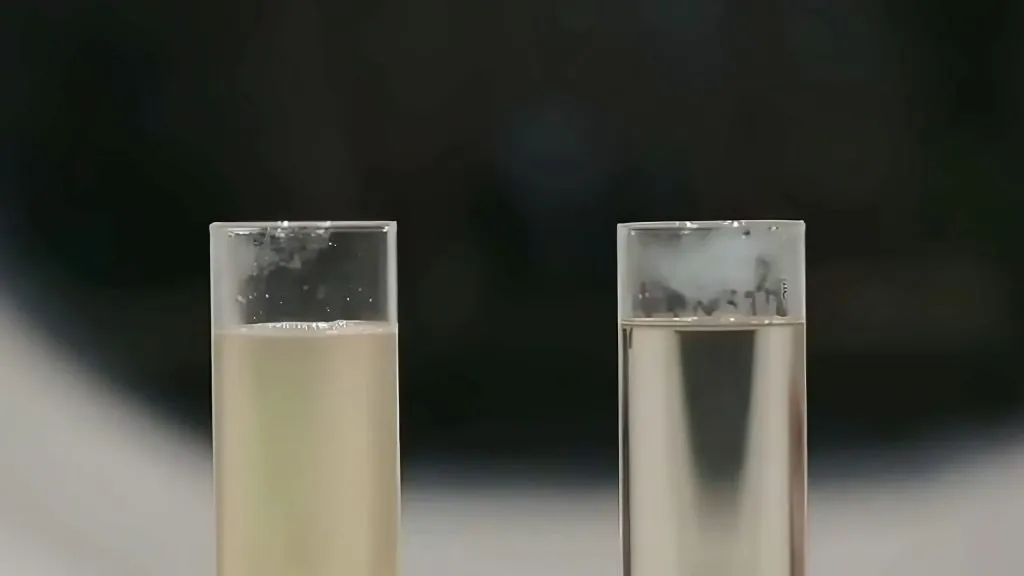
- Extreme Requirements for Physical Stability : Biochemical products are placed directly into the optical path of precision analytical instruments. If turbidity and dissolution clarity are poorly controlled, light scattering caused by micro-particles will directly compromise the signal-to-noise ratio of spectrophotometric analysis — a metric that general chemical products never address.

III. In-Depth Analysis : Why Can Biochemical Brands Bridge the Quality Gap ?
The reason many products from professional biochemical brands demonstrate irreplaceable superiority lies in their possession of a sophisticated internal control system deeply embedded in the core of production.
- Benchmark Alignment of Kinetic Behavior : Biochemical brands conduct specific enzyme kinetic benchmarking to ensure products exhibit fully predictable reaction behavior in simulated biochemical pathways.
- Matrix Effects and Thermodynamic Stability : Through strict validation of dissociation constants and thermodynamic stability, they ensure that products do not experience drift in their dissociation state within physiological buffer systems of varying ionic strengths.

- Batch Reproducibility Under Standardized Processes : By adopting the “Quality by Design (QbD)” philosophy, they strictly control the conversion efficiency of intermediates, thoroughly eliminating “invisible by-products” caused by variations in synthetic pathways between batches, and ensuring high robustness of data across batches.
IV. Re-examining Cost and Value : The Collective Choice of Global Research Hubs
Undeniably, due to the aforementioned meticulous internal controls, the listed price of such biochemical products may be higher than generic alternatives. However, from a scientific research perspective, this is, in fact, “cost-saving.” It virtually eliminates experimental failures and the need for data re-runs caused by raw material issues, significantly shortens the path to research optimization, and provides a powerful endorsement for the credibility of experimental conclusions.

It is precisely based on the pursuit of “experimental certainty” that ChemWhat has been widely adopted by world-leading institutions, including Harvard University, Cornell University, the University of Cambridge, ETH Zurich, the National University of Singapore, and Seoul National University. For these research hubs, choosing ChemWhat represents the scientific community’s collective consensus on high-standard, highly reproducible experimental workflows.
Conclusion
When using ChemWhat biochemical products, researchers receive not just a chemical, but “certainty.” In the competitive world of research where time is life, choosing high-quality products is the most economical investment for achieving a higher success rate.
Related Products
Phosphoenol pyruvate monopotassium salt CAS 4265-07-0
Phosphoenolpyruvic acid cyclohexylammonium salt CAS 10526-80-4

![Structure of N-[3-(Diethoxymethylsilyl)propyl]ethylenediamine CAS 70240-34-5](https://www.watson-int.com/wp-content/uploads/2019/12/Structure-of-N-3-Diethoxymethylsilylpropylethylenediamine-CAS-70240-34-5.png "Structure of N-[3-(Diethoxymethylsilyl)propyl]ethylenediamine <span class=\"caps\">CAS</span> 70240-34-5")