
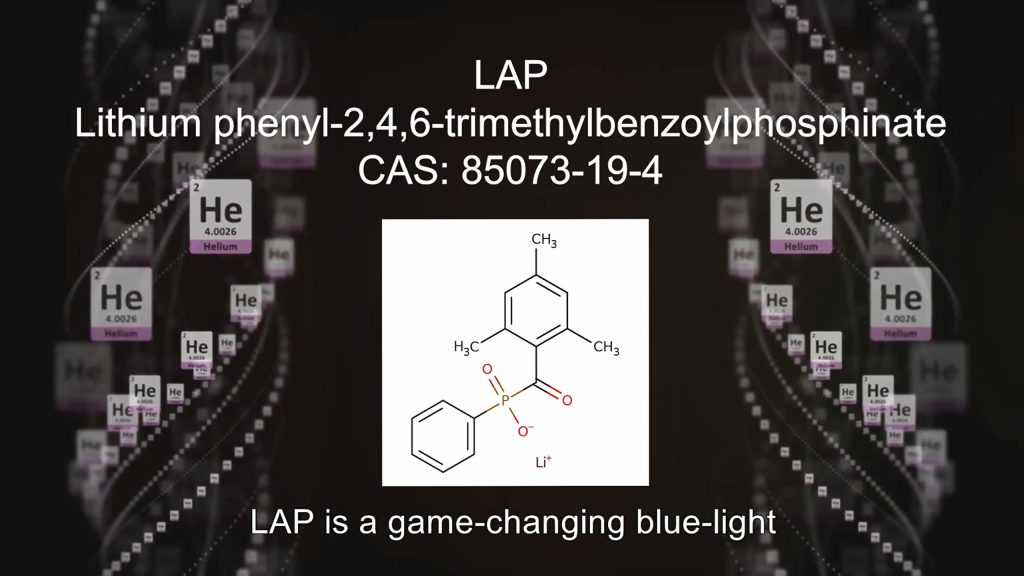
With the rapid advancement of 3D printing, biomaterials, and photopolymerization technologies, the demand for efficient, low-toxicity photoinitiators has become increasingly urgent. LAP (Lithium phenyl-2,4,6-trimethylbenzoylphosphinate) is an innovative compound that has garnered significant attention for its role as a photoinitiator in various hydrogel formulations. As a blue light photoinitiator, LAP operates under blue light, rapidly initiating the curing of photosensitive hydrogel materials. This compound is particularly well-suited for use in photopolymer formulations, including hydrogel-based materials for 3D printing, coatings, inks, and bio-printing applications. LAP represents a significant advancement in the field of photoinitiators, offering several advantages over traditional UV-based photoinitiators. Due to its exceptional performance and broad range of applications, LAP has become a key player in photopolymerization technologies. In this article, we will explore the properties, applications, and benefits of LAP, as well as its potential in both biomedical and industrial sectors.
Key Characteristics
LAP possesses several distinctive properties that make it highly effective and versatile :
- Excellent Water Solubility : LAP demonstrates outstanding solubility in water, with a dissolution rate of 4.7 wt%. This makes it an ideal choice for water-based formulations, ensuring easy integration into various hydrogel systems without causing precipitation or instability.
- Long Wavelength Absorption : LAP effectively cures under violet and blue light in the range of 350-410 nm, particularly at 405 nm. This allows the use of longer-wavelength light, which causes less cellular and tissue damage compared to traditional ultraviolet (UV) wavelengths.
- High Reactivity and Low Toxicity : LAP exhibits excellent cell compatibility, making it suitable for biomedical applications such as tissue engineering and cell-based 3D printing. At the recommended concentrations, LAP demonstrates superior photoinitiating capabilities without exhibiting detectable cytotoxicity.
- Avoidance of Alkaline Additives : It is important to avoid contact with alkaline additives when using LAP, as they may interfere with its reactivity and overall performance.
Applications of LAP
LAP finds broad applications across various industries, particularly in areas where precise control over the curing of photosensitive materials is required :
- 3D Printing : LAP is widely used in water-based 3D printing applications, particularly in bio-printing, where the use of biocompatible photoinitiators is essential. It enables rapid and efficient curing of hydrogels used in printing tissue engineering and regenerative medicine scaffolds.
- Bio-Printing : In bio-printing, LAP facilitates the crosslinking of hydrogels containing live cells, providing a non-toxic, efficient, and controllable method for creating complex 3D cell-laden structures. Its long-wavelength absorption ensures that cells are not harmed by the curing light, making it ideal for creating viable tissue constructs.
- Water-Based Coatings and Inks : LAP is also used in water-based coatings and inks, where it acts as a photoinitiator to cure the formulation under blue light. Its high-water solubility and low toxicity make it an excellent choice for developing environmentally friendly and safe coatings and inks.
- Cell-Based Hydrogel Curing : LAP is effective in curing cell-laden hydrogels, making it an ideal option for applications such as cell encapsulation or tissue engineering. The ability to use blue light allows for fine control over the curing process without the harmful effects of UV light.
- Long Wavelength Curing Systems : LAP is highly effective in long-wavelength curing systems, where its ability to absorb light in the 350-410 nm range is particularly beneficial. This feature expands its application to specialized curing processes that require precise light control.
Cost Optimization : A Key to Industrialization
Given LAP’s performance advantages and increasing market demand, our team has made significant progress in process development, establishing a mature manufacturing technology that paves the way for large-scale production. By optimizing production workflows and raw material sourcing, we aim to reduce costs, making LAP more competitive in the market and fostering its widespread adoption in photopolymerization materials and bio-printing applications.
Future Outlook
Its highly efficient photopolymerization properties and biocompatibility hold tremendous potential in fields such as medicine, materials science, and 3D printing. As we continue to optimize LAP’s production technology, this photoinitiator will drive innovative applications at a lower cost and higher performance, facilitating the deeper integration of research and industry. The introduction of LAP marks a new era for photopolymerization and hydrogel technologies. Looking forward, we will continue to explore its potential across various fields, accelerating technological innovation and industrial advancement.
Sales Link
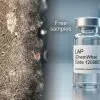
Lithium phenyl-2,4,6-trimethylbenzoylphosphinate (LAP) CAS 85073-19-4 on Watson
![1,1'-(Methylene-di-4,1-phenylene)bis[2-hydroxy-2-methyl-1-propanone] CAS 474510-57-1](https://www.watson-int.com/wp-content/uploads/2023/03/474510-57-1-100x100.jpg)

![structure of 1-[4-(Phenylthio)phenyl]-1,2-octanedione 2-(O-benzoyloxime) CAS 253585-83-0](https://www.watson-int.com/wp-content/uploads/2024/05/structure-of-1-4-Phenylthiophenyl-12-octanedione-2-O-benzoyloxime-CAS-253585-83-0-100x100.png)