Rising Silver Prices Drive Materials Innovation
From late 2025 to early 2026, surging silver prices placed unprecedented cost pressure on the photovoltaic and electronics manufacturing industries, bringing silver-coated copper (Ag@Cu) powders into the spotlight as a composite material that balances conductivity and cost efficiency.
For heterojunction (HJT) solar cells, where silver paste accounts for a significant share of production costs, reducing silver consumption has become a key factor in competitiveness. In conductive adhesives, inks, electromagnetic shielding, and electronic components, the need to control precious-metal costs while maintaining electrical performance and long-term reliability is also driving the development of alternative materials.
Ag@Cu Powders : Balancing Conductivity, Stability, and Cost
The value of Ag@Cu powders lies not simply in replacing silver with copper, but in engineering a material structure that balances conductivity, oxidation resistance, and cost.
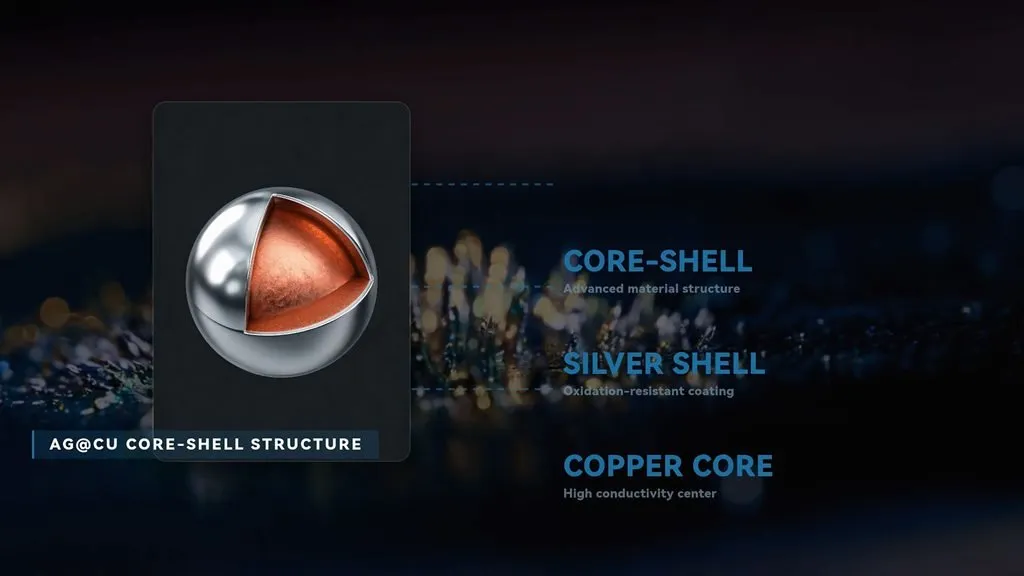
Also known as silver-plated copper powders, these materials feature a core-shell structure in which copper forms the core and silver coats the surface. The copper core provides the primary conductive framework and helps control material costs, while the silver shell improves surface oxidation resistance and electrical contact.
Compared with pure silver powders, Ag@Cu powders reduce silver consumption. Compared with pure copper powders, the silver coating helps protect against oxidation and improves interfacial performance in conductive systems. Their key advantage is therefore not simply a lower silver content, but the ability to maintain a continuous, dense, and stable silver coating while reducing silver usage.
For low-temperature HJT conductive pastes and electronic materials requiring reliable dispersion, conductivity, and environmental stability, the interaction between shell quality and core characteristics is particularly important.
Chemical Coating : The Key to Ag@Cu Performance
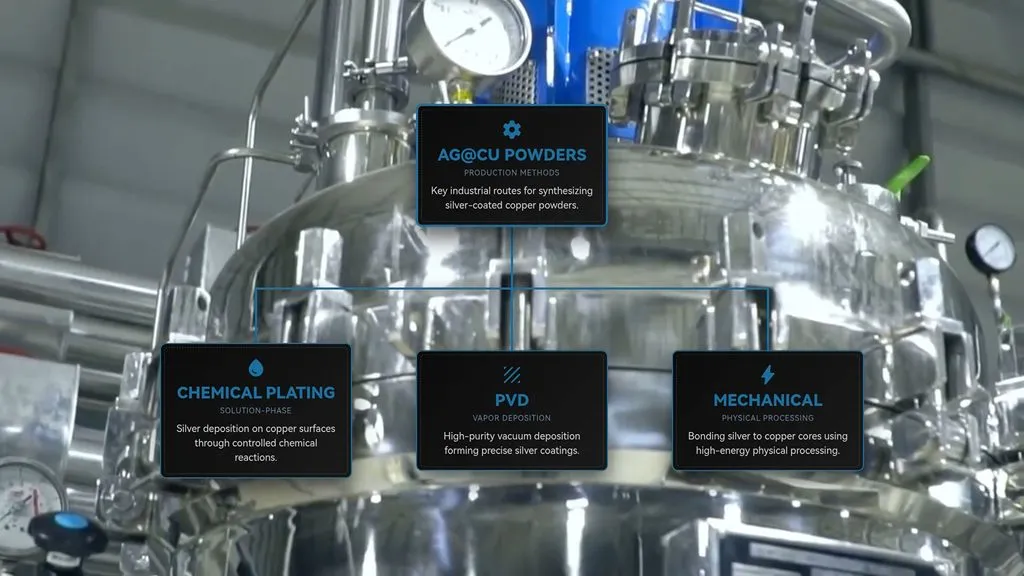
Ag@Cu powders can be produced through several methods, including chemical plating, physical vapor deposition (PVD), and mechanical processing. Chemical methods enable silver deposition and growth on copper surfaces through controlled solution-phase reactions. Their relatively flexible processing requirements and manageable equipment costs make them an important industrial production route.
However, successful silver deposition alone does not guarantee high-performance powders. Copper particle size distribution, sphericity, and surface cleanliness affect silver nucleation and growth, while reaction chemistry and kinetics influence coating uniformity. Pinholes, gaps, or uneven coating thickness can expose the copper core to oxidation, compromising conductivity and storage stability.
The real technical challenge is to achieve uniform, dense, and stable silver coatings through coordinated control of copper-core properties and chemical deposition processes. Silver content, particle morphology, size distribution, tap density, and surface characteristics must be optimized together according to the customer’s formulation, curing conditions, and end-use requirements.
Polyberg’s Ag@Cu Powders : Two Complementary Product Lines
Building on this approach, Polyberg has developed two complementary Ag@Cu powder product lines through technical collaboration with ChemWhat and under its brand authorization.
Spherical Ag@Cu Powders
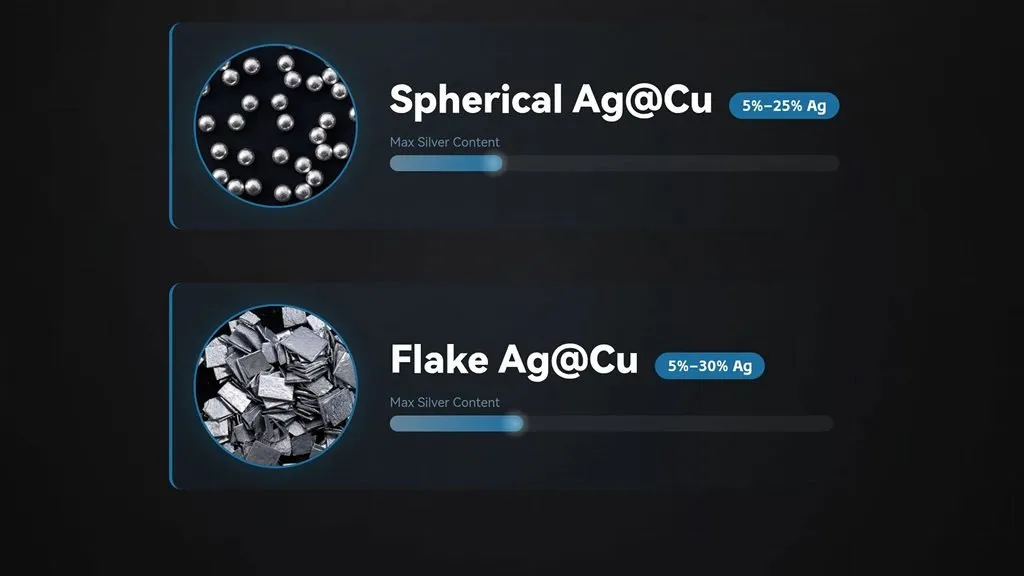
With adjustable silver contents of 5% – 25%, spherical Ag@Cu powders are designed primarily for low-temperature HJT conductive pastes, advanced circuit pastes, electromagnetic shielding, and thermal management materials.
Flake-Shaped Ag@Cu Powders
With adjustable silver contents of 5% – 30%, flake-shaped Ag@Cu powders are suitable for conductive adhesives, electromagnetic wave-absorbing and functional coatings, and thermal management applications.
The two product lines address different particle-packing characteristics, electrical contact mechanisms, and formulation requirements. Silver content, particle size distribution, tap density, and surface modification can be tailored to improve dispersion, compatibility, and performance in specific paste or adhesive systems.
Lower silver content, however, does not automatically translate into better overall performance. Coating integrity, core morphology, conductive network formation, curing compatibility, and long-term reliability must all be assessed through appropriate material characterization and application testing. Final specifications should therefore be confirmed according to each customer’s requirements and test results.
Nano Silver Powders : Maximizing the Value of Silver
While Ag@Cu powders reduce silver consumption, nano silver powders take a different approach : maximizing the functional value of silver through particle-size and surface engineering.
As silicon carbide (SiC) and gallium nitride (GaN) power devices advance, silver sintering is becoming an important die-attach technology due to its thermal conductivity and potential for high-temperature reliability. Meanwhile, low-temperature sintering pastes, precision electronic circuits, and touchscreen pastes demand increasingly precise control over particle size distribution, dispersion, and sintering activity.
Polyberg’s spherical nano silver powders cover particle sizes from 30 to 100 nm, offering options for different applications. Smaller particles are primarily intended for low-temperature sintering, high-conductivity pastes, and low-silver-content formulations, while larger particles can support sintering-activity modification and specialized functional materials.
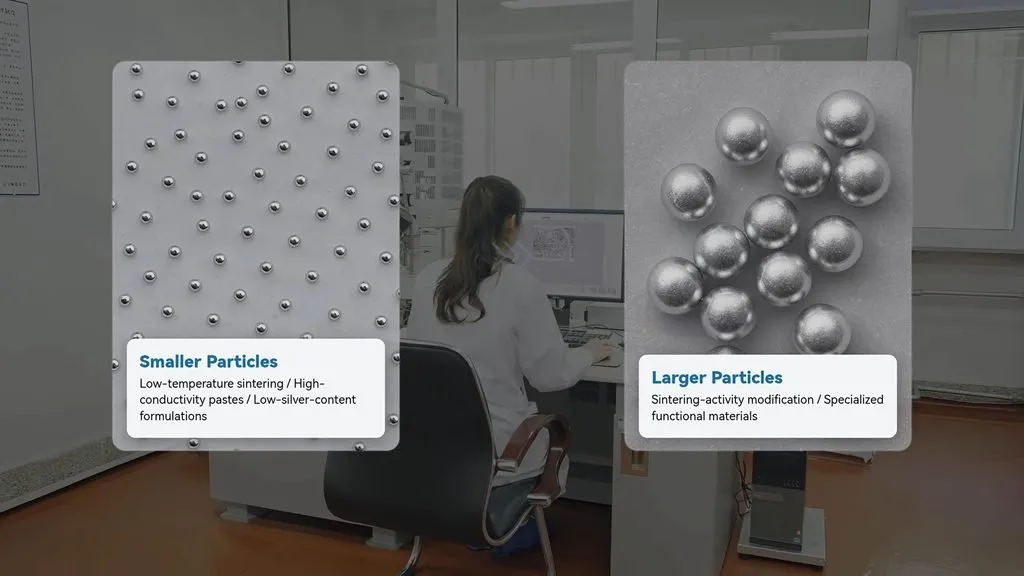
By selecting appropriate particle sizes and surface characteristics, customers can optimize sintering temperature windows, conductive network structures, and functional performance in combination with their formulations and processing conditions.
From Material Properties to Application Performance
Although Ag@Cu and nano silver powders follow different material-design strategies, both reflect a broader industry shift. Conductive materials are increasingly evaluated not only by raw-material cost or nominal conductivity, but also by microstructure, interfacial properties, process compatibility, and performance in real applications.
For material suppliers, technical capability extends beyond product specifications. Reliable particle morphology and size data, consistent batch quality, application-specific surface treatments, and collaborative formulation testing are essential to successful downstream adoption.
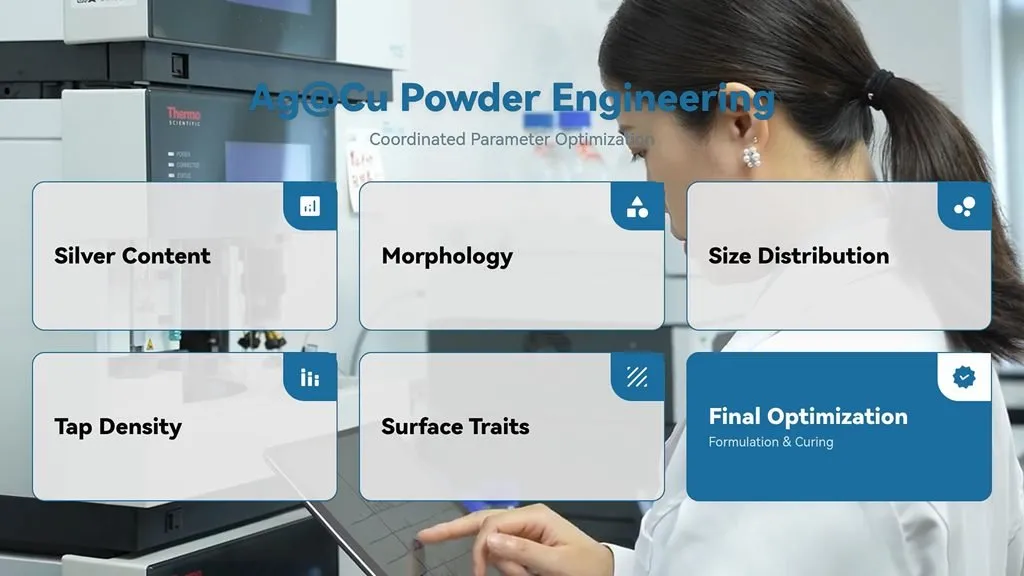
Through its Ag@Cu and nano silver product lines, Polyberg aims to provide tailored material solutions for photovoltaic, power semiconductor, and precision electronics manufacturing by optimizing particle morphology, silver content, particle size, and surface properties.
Engineering Better Materials for the Next Generation of Electronics
Amid silver-price volatility and continued pressure to reduce manufacturing costs, materials innovation is not simply about replacing one metal with another. It is about making every component work more effectively while meeting performance, reliability, and processing requirements.
Whether through precision chemical coating in Ag@Cu powders or particle-size engineering in nano silver powders, long-term value ultimately depends on achieving a reliable, verifiable match between material structure, manufacturing processes, and downstream application needs.